Confucianism
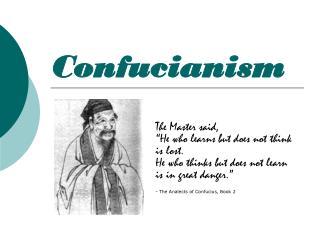
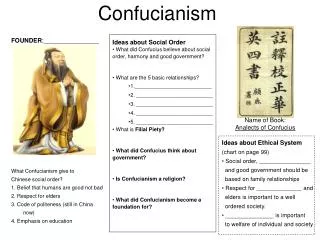
Confucianism, established by Confucius in 551 B.C., has profoundly shaped social structures and governance in China and beyond. Emphasizing social order, good government, and the importance of harmonious relationships, his teachings focus on essential principles like filial piety and the responsibility of rulers to educate themselves for effective governance. The Analects, recorded by his students, encapsulate his thoughts, which influenced not just China but permeated Korean, Japanese, and Vietnamese cultures, impacting nearly a third of the world's population.

Confucianism
E N D
Presentation Transcript
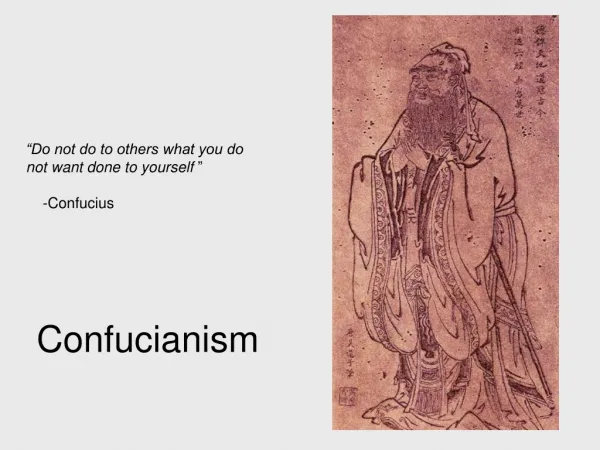
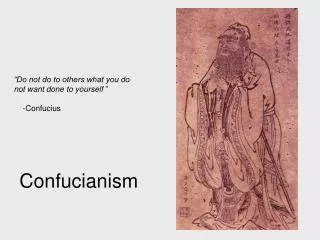
Philosophy and Religion in China The Wisdom of Confucius • Born in 551 B.C. to a noble, but poor family • Became a great teacher / philosopher • More interested in social order and good gov’t than in religion • Students wrote his sayings in the Analects.
Five Relationships: • Harmony results when people accept their place in society • Filial piety (respect for parents) was above all others • Gov’t had resp to provide good gov’t • Leaders would be educated • After his death, even Chinese rulers relied on Confucian ideas • Korea, Japan, & Vietnam also accepted his beliefs (almost 1/3 world’s pop)
Geomancy/FengShiu A fengshui spiral in Chinatown. Los Angeles, CA, USA.