Key Concepts of Special Relativity: Events, Reference Frames, and Time Dilation Explained
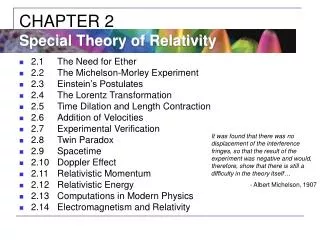
This chapter delves into essential concepts of special relativity, covering fundamental ideas such as events and inertial reference frames. An event is defined as a physical occurrence at a specific time and place within a reference frame, which consists of coordinate axes and clocks. Key postulates include the relativity of physical laws across inertial frames and the constancy of the speed of light. It further explores time dilation and length contraction due to relative motion, as well as the conservation of relativistic momentum and the equivalence of mass and energy.

Key Concepts of Special Relativity: Events, Reference Frames, and Time Dilation Explained
E N D
Presentation Transcript
Chapter 28: Special Relativity Essential Concepts and Summary
Events and Inertial Reference Frames • Event: a physical "happening" that occurs at a certain place and time • Reference frame: a set of x,y,z axes (coordinate system) and a clock • Inertial reference frame: one in which Newton's law of inertia is valid. • No such thing as "absolute" reference frame • Any inertial frame is as good as any other for expressing laws of physics
Postulates of Special Relativity • Postulate: fundamental assumption • 1. Relativity Postulate: The laws of physics are the same in every inertial reference frame • 2. Speed of Light Postulate: The speed of light in a vacuum, measured in any inertial reference frame, always has the value c, regardless of the speed of observer and the source of light. • Called special because its applies only to the special case of frames of reference moving at a constant speed relative to each other
Because speed of light is always constant, and speed is distance over time, some other constant has to change. In special relativity, a phenomenon called time dilation occurs. In the previous picture, we look at the astronaut from his own reference frame, then an outside, still inertial, reference frame Time Dilation
Because of time dilation, relativistic length is less than the proper length between two points Length contraction only occurs in the direction of motion Length Contraction
Like speed and time, relativity modifies our ideas about momentum. Like normal momentum, however, relativistic momentum in an isolated system is conserved Relativistic Momentum
One of the most amazing results of special relativity is mass and energy are equivalent. Rest energy of an object is the special case when its velocity is 0 Equivalence of Mass and Energy
For a general situation, the relative velocities are related by the velocity addition formula. At speeds much below the speed of light, this is equivalent to our current understanding of addition of velocities Vxy is velocity of object X relative to object Y Relativistic Addition of Velocities