Understanding Bacteria, Viruses, and the Immune System: A Comprehensive Overview
This chapter delves into the realms of bacteria and viruses, exploring their roles in disease and the body's defense mechanisms. It covers the characteristics of bacteria, including their beneficial and pathogenic forms, the nature of viruses, and how both pathogens can disrupt homeostasis. The immune system's response, including the role of antibodies and white blood cells, is examined. Insights into preventing infections through vaccination and the implications of prions and viroids are also provided, emphasizing the importance of maintaining internal balance against external threats.

Understanding Bacteria, Viruses, and the Immune System: A Comprehensive Overview
E N D
Presentation Transcript
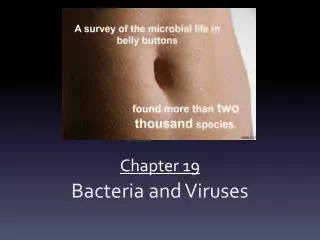
Chapter 19 Bacteria and Viruses
Remember homeostasis? • Maintaining proper internal conditions • pH, temp., water/salt balance, O2, CO2, etc.
Factors for Disease • 1. genetics- inheritance • 2. microorganisms • pathogen: disease-causing agent • 3. pollutants/poisons (ex: asbestos, lead) • 4. organ malfunction • 5. harmful lifestyles (tobacco, alcohol, lack of nutritionor exercise)
19-1 Bacteria • Prokaryotes • Monera • Can be beneficial or disease-causing • Good: intestinal bacteria • Bad: strep throat, pneumonia • Everywhere!
Identified by: • Shape- bacilli (rod), cocci (round), spirilla (spiral) • Cell walls- Gram +/- (peptidoglycan) • Movement- flagella, slime • Metabolic diversity- heterotrophs and autotrophs (chemo- or photo-)
Bacteria Energy Production • Respiration or fermentation (with or without O2) • Obligate aerobes: needs O2 to live • Obligate anaerobes: cannot live with O2 • Facultative anaerobes: can live with or without O2
Bacteria Reproduction • Binary fission: (asexual) DNA is replicated and the organism splits in half • Conjugation:(sexual) genetic info is exchanged across a “bridge” • Spore formation: haploid cell that can withstand hard conditions and form a new organisms when the time is right
Importance of Bacteria • Decomposers- break things down • Nitrogen fixation- cycles N thru atmosphere • Human uses: food, oil spills, medicine, intestines
Treating Bacteria • Bacteria have homeostasis too! Change the conditions to stop growth • Temp, salt, pH, etc. • Sterilization (heat), disinfection (chemicals) • Antibiotics- kill bacteria or stop reproduction
19-2 Viruses • Categorized by what they infect: • Plant, animal, bacteriophage • Capsid- protein coat- signifies which host to infect (host must have a receptor) • NOT alive- has genetic material but can’t repro on own • Ex: flu virus, HIV
Virus Replication • Lytic: enters host cell, copies itself continuously and bursts (lyses) • Lysogenic: combines/replicates viral DNA with host DNA • Prophage: viral DNA embedded within host DNA
Treating Viruses • Antibiotics WILL NOT work! • Prevention is key! • Vaccination: inject a weak form of a virus in order to get the antibodies (immunity)
The Body’s Defense System • homeostasis=includes regulating microbes • Lines of defense: • 1. physical barriers- block entry (skin) • 2. inflammation- increased blood flow • 3. immune system
Immune System • Recognizes the “bad guys” • Every bacteria/virus has antigens (proteins) • Immune system makes antibodies • Antibodies fight the antigens • Vaccines- shows antigens ahead of time- allows body to create antibodies (immunity)
White Blood Cells (WBCs) • Immune system MVP • 2 types: • 1. B cells: make antibodies • Memory B cells • 2. T cells: • Killer T cells: kill infected cells • Helper T cells*: help all other WBCs
When the immune system goes wrong… • Allergic reactions- increase in system- produces histamines • Autoimmune diseases- system attacks self • Immunodeficiency- decrease in system- helper T cells destroyed (ex: AIDS) • inflammation- older people
Viroids and Prions • Viroids: single stranded RNA molecules enter infected cells • Prions: tiny protein particles enter the brain and affect the nervous system- no DNA/RNA • Ex: mad cow disease
20-1 The Kingdom Protista • What is a protist? • Anything that is not a plant, animal, fungus or prokaryote • First eukaryotes • Most unicellular • Classified by how they obtain nutrients
20-2 AnimallikeProtists (Protozoans) • Heterotrophs • Categorized by how they move: • Flagella • pseudopodia: temporary projection of cytoplasm • food vacuole • cilium: short hair-like projections • parasitic- don’t move on own
AnimallikeProtists and Disease • Malaria (mosquitoes) • Treatments/vaccines only partially effective • African sleeping sickness (tsetse fly) • Unconsciousness can be fatal
20-3 Plantlike Protists (Unicellular Algae) • Chlorophyll and accessory pigments • Ex: diatoms and dinoflagellates (glowing water!)
20-4 Plantlike Protists (Red, Brown and Green Algae) • Red algae- good at harvesting light E- can live at great depths • Brown algae- brown pigment • Green algae- VERY plantlike
Human uses of algae • “grasses” of the sea- base of food chain • O2 production • Medicine- vitamin C and iron • Food- sushi wraps, ice cream/pudding thickener • Industry- plastics, agar
20-5 FunguslikeProtists • Recycle organic matter • Different cell walls than true fungi • Slime molds • Water molds- potato famine
Ecology of Protists • Base of food chain (ex: phytoplankton) • Symbiotic relationships (ex: termites) • Blooms (ex: red tide) • Recycle organic matter (ex: slime molds)
21-1 What is a fungus? • Eukaryotic heterotrophs with cell walls (chitin) • Digest food externally then absorb it • Can be parasitic
Fungi Structure • Hyphae: microfilaments that combine to form mycelium • Increase surface area to absorb food • Fruiting body: reproductive structure • “mushroom”
Fungi Reproduction • Asexual: cells/hyphae break off • Sexual: mating types “+” and “-” • Spores: easily spread
21-2 Classification • Based on structure and reproduction • Common molds (bread mold) • Sac fungi (yeasts) • Club fungi • Imperfect fungi (unknown repro. cycle)
21-3 Fungi Ecology • Saprobes- obtain nutrients from decaying organisms • Decomposers- recycle nutrients back into earth
Ecological Relationships • Parasites- affect crops (wheat rust) and humans (athletes foot, ringworm) • Symbionts (symbiosis) - work together with other organisms • Lichens- photosynthetic organisms + fungus • Mycorrhizae- roots + fungus