Understanding Cloud Formation: Humidity, Lifting Mechanisms, and Key Terms
This article explains the fundamental concepts of cloud formation, starting with humidity—the amount of water vapor in the air measured as relative humidity and dew point. It discusses the cooling and warming of air through expansion and compression, highlighting the Dry and Wet Adiabatic Rates. Additionally, it describes four methods of lifting air to facilitate cloud formation: Orographic lifting, Frontal wedging, Convergence, and Convective lifting. Clouds form at the dew point and require condensation nuclei like dust and salt particles to develop.

Understanding Cloud Formation: Humidity, Lifting Mechanisms, and Key Terms
E N D
Presentation Transcript
Important Terms • Humidity: The amount of water vapor in the air • Humidity can be measured two ways • Relative Humidity: how much water vapor the air is holding, expressed in percent form. Ex., the humidity is at 60% • Dew Point: The temperature of air when it is at 100% saturation with water vapor • At the dew point, water vapor condenses (becomes a liquid) and can form clouds, dew, fog, etc.
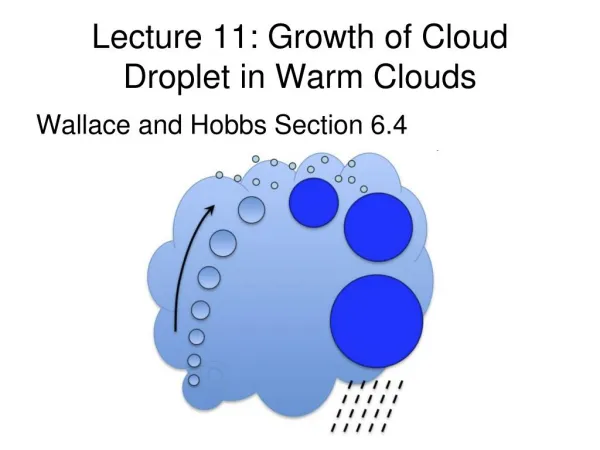
Cloud Formation • When air expands, it cools • When it compresses, it warms • If air cools enough it hits the dew point • Now the biggie: • When air rises it expands and cools • When air falls it compresses and heats
Dry Adiabatic Rate • When dry air rises it cools • For every 1000 meters you go up, air will cool 10 deg C and vice versa • This is called the Dry Adiabatic Rate
Wet Adiabatic Rate • If air rises high enough it will hit the dew point • If it continues to rise the air will cool at only 5-9 deg C for every 1000 meters and vice versa • This is called the wet adiabatic rate
What Does it Mean? • If you raise air high enough it will cool until it hits the dew point • At that point you will start making a cloud • So the next question is…how do you get the air to rise?
How Do You Lift Air? • Lifting cools air so clouds are made • There are four ways to lift clouds • 1. Orographic Lifting • 2. Frontal Wedging • 3. Convergence • 4. Convective Lifting
# 1Orographic Lifting Air runs into a mountain a rises high up one side It rains a lot on one side and is very dry on the other.
#2 Frontal Wedging A mass of cold air collides with a mass of warm air They are like huge armies meeting at the front. The warm air rides up and high over the cold air.
#3 Convergence Two winds coming from two different directions collide. They can’t go down so the air goes up - fast
#4 Convective Lifting Hot spots on the land, like a huge parking lot can cause bubbles of air to rise. These bubbles are called thermals and can lead to big clouds.
Last Thoughts • Clouds only form at the dew point • They also need condensation nuclei to form around. • Condensation nuclei can be dust, smoke, salt particles from the ocean, etc. • Clouds are not vapor but actually water or ice particles