Understanding the OSI Model: The Application Layer Explained
The OSI Model is a fundamental framework in telecommunications, encompassing seven layers that facilitate communication between endpoints in a network. The topmost layer, known as the Application Layer, plays a crucial role in providing user services. It identifies communication partners and addresses quality of service, user authentication, and privacy concerns. This layer supports various applications like file transfers, email, and web browsing, and includes protocols such as Telnet, FTP, and HTTP, ensuring a seamless interface for users accessing network services.

Understanding the OSI Model: The Application Layer Explained
E N D
Presentation Transcript
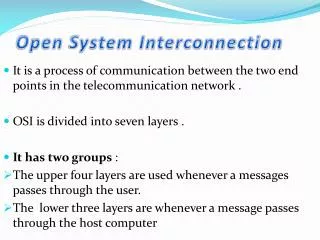
Open System Interconnection • It is a process of communication between the two end points in the telecommunication network . • OSI is divided into seven layers . • It has two groups : • The upper four layers are used whenever a messages passes through the user. • The lower three layers are whenever a message passes through the host computer
LAYER 7-APPLICATION LAYER • This layer is responsible to provide service to user. • It is a layer in which communication partners are identified. • Quality of the service is identified. • User authentication and privacy are considered.
The top layer of the OSI model. • Provides a set of interfaces for sending and receiving applications to gain access to and use network services, such as: networked file transfer, message handling and database query processing. • The application layer is responsible for providing services to the user.
This layer provide service for file transfer, • E mail and other network software. • Telnet , FTP & HTTP are application that exist.
Application layer The application layer is responsible for providing services to the user.