Cinematic composition
Cinematic composition. Cinematographer. Cinematographer= also known as Director of Photography (DP) Responsible for artistic and technical decisions related to images captured on screen In charge of camera crews, lighting crews, etc. The Big Picture.
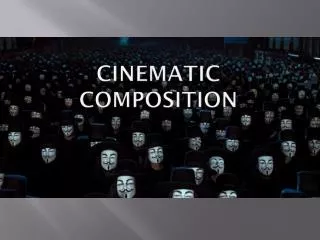

Cinematic composition
E N D
Presentation Transcript
Cinematographer • Cinematographer= also known as Director of Photography (DP) • Responsible for artistic and technical decisions related to images captured on screen • In charge of camera crews, lighting crews, etc.
The Big Picture • Every shot the cinematographer makes must be designed with the goals of cinematic composition in mind. • Especially attendant to the Mise-en-Scene! Sunset Boulevard - Billy Wilder (1950)
Goals of cinematic composition • Goal 1: Directing attention to the object of greatest significance Road to Perdition – Sam Mendes (2002) American Beauty, Revolutionary Road, Skyfall
Goals of cinematic composition • Goal 2: Keeping the image in constant motion Indiana Jones and the Kingdom of the Crystal Skull – Stephen Spielberg (2008)
Goals of cinematic composition • Goal 3: Creating an illusion of depth Hugo – Martin Scorsese (2011) Taxi Driver, Raging Bull, Goodfellas, Casino, The Departed, Shutter Island, Gangs of New York…
Size and Closeness of an Object • Normally the eye is directed toward larger and closer objects rather than smaller and distant objects. • Foreground= closer to the camera, thus larger • Background= further from the camera, thus smaller
Foreground versus Background in V for Vendetta (2005, James McTeigue)
Foreground versus Background in V for Vendetta (2005, James McTeigue)
Sharpness of Focus • The eye is drawn to what it can see best • Sharp Focus= image that is clear • Soft Focus= image that is blurry Pan’s Labyrinth (2006 – Guillermo del Toro, Hellboy)
Sharpness of Focus • May overrule foreground/background rule
Movement • Objects in motion draw the eye • A moving object can divert our attention from a static one • Constant movement in the background may not divert our attention from the still but more important objects in the foreground Chariots of Fire (1981 – Hugh Hudson)
Extreme Close-Up Objects featured in extreme close-up give the audience nothing else to see!
Arrangement • There are no specific positioning formulas, but a director will arrange people and objects in relation to each other. • Possibilities: • Symmetry • Pyramid • Balance
Symmetrical Arrangement Eyes Wide Shut (1999) Stanley Kubrick 2001, Dr. Strangelove, Full Metal Jacket, The Shining, A Clockwork Orange
Pyramid Arrangement Reservoir Dogs (1992– Quentin Tarrantino)
Dynamic Arrangement The Hunger Games (2012) (Gary Ross) Seabiscuit, Pleasantville
Framing • Think of a picture frame. • Draws attention to the object of greatest significance, the object being framed • May add symbolism
Lighting and Color • Used for focus, symbolism, emphasis, etc. • Light versus Darkness Establishes Contrast
Color Schindler’s List (1993 – Spielberg)
Dramatic Lighting Citizen Kane