Endocrine System
The endocrine system plays a crucial role in regulating bodily functions through hormones, which are chemical messengers secreted by ductless glands into the bloodstream. Key glands include the pituitary, thyroid, adrenal, and gonads. Hormones control various processes like growth, metabolism, and stress response. Feedback mechanisms ensure hormone levels remain balanced, while nervous control triggers hormone release during stress. Conditions like gigantism, dwarfism, and hyperthyroidism illustrate the importance of proper endocrine function.

Endocrine System
E N D
Presentation Transcript
Endocrine System Splawn
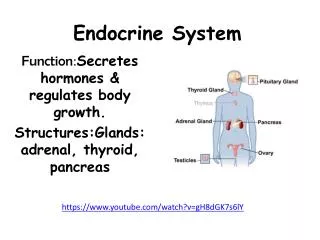
Function of the Endocrine System • The function of the endocrine system is to secrete hormones or chemical messengers to target cells
Glands • Endocrine glands-ductless, internal secretion, secrete hormones directly into bloodstream • Exocrine glands-substance secreted must go through a duct. Sweat, salivary, lacrimal, pancreas
Hormone • Chemical messenger that tells target cells or organs how to act. • Hormones are made by the glands. • The glands pull materials from the blood and lymph to create hormones
Hormone Control-Negative Feedback • Negative Feedback * Blood level of hormone gets low * Message to brain that hormone level low *Areas in brain send out message to gland telling it that it needs to produce more hormone *When blood levels of hormones increase, brain gets that message and brain hormones stop
Hormone under nervous control • Under the nervous system, stress can cause a release of adrenalin.
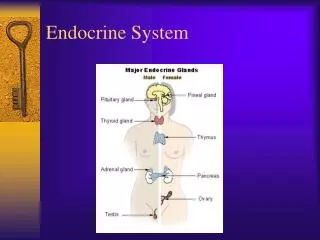
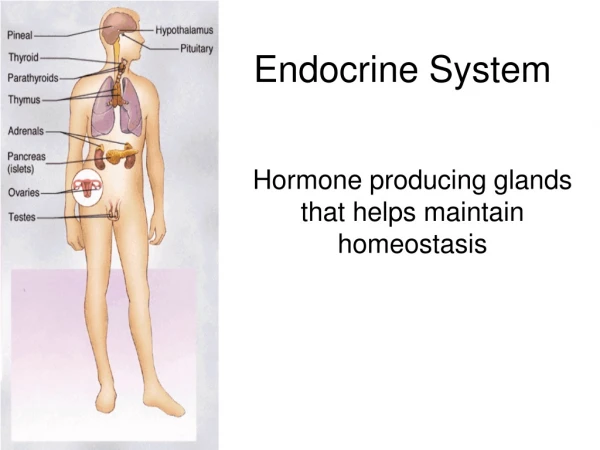
Major glands of the endocrine system • Pituitary • Pineal • Thyroid • Parathyroid • Thymus • Adrenal • Gonads • Pancreas
Pituitary Gland • The master gland • Size of grape • Located at base of brain • Connected to hypothalamus • Divided into anterior and posterior lobes
Anterior Pituitary • Larger of the two lobes • Produces these 8 hormones
Anterior Pituitary Hormones • Growth hormone –GH- growth & development • Prolactin hormone- PRL-breast tissue, milk • Thyroid-stimulating hormone-TSH-thyroid gland • Adrenocorticotropic hormone-ACTH-adrenal cortex
Anterior Pituitary Hormones • Follicle stimulating hormone-FSH-growth of graafian follicle and production of estrogen in females and sperm in males • Luteinizing hormone-LH-stimulates ovulation and formation of corpus luteum. Controls progesterone in females • Interstitial cell-stimulating hormone-ICSH-testosterone in males • Melanocyte-stimulating hormone-MSH-responsible for increasing skin pigmentation
Posterior Pituitary Gland • Vasopressin-converts to antidiuretic hormone in the bloodstream. Acts on kidney to concentrate the urine and preserve H2O in body • Oxytocin-released during childbirth causing contractions in the uterus
Pineal Gland • Shaped like a pine cone • Stimulated by the amount of light that enters eyes • Hits the optic nerve causing production of melatonin • The darker it is, the more melatonin produced • The lighter it is, the less melatonin produced • Melatonin is related to our sleep cycle and body temperature
Thyroid gland • Butterfly-shaped mass of tissue • On either side of larynx, over trachea • H-shaped • 2 inches ling
Thyroid Gland • Secretes three hormones • Thyroxin, triiodothyronine, and calcitonin. • Thyroxin and triiodothyronine control metabolism • Calcitonin controls calcium concentration in body, prevent hypocalemia
Parathyroid Gland • Four glands • Each the size of a grain of rice • Attached to the posterior thyroid gland • Secrete parathormone which works with calcitonin to control blood calcium levels
Thymus • Endocrine gland and lymphatic organ • Located behind sternum, above and in front of heart • Begins to get smaller at puberty • Thymosin -helps stimulate T-cell production for immune response
Adrenal Gland • Located on top of each kidney • Each gland has two parts: the cortex and medulla • The adrenal cortex secretes corticoids (anti-inflammatory) and sex hormones (androgens) • The adrenal medulla secretes epinephrine (adrenalin) and norepinephrine – fight or flight hormones
Gonads • Ovary in female • Testes in males
Gonads • Sex glands • Ovary responsible for producing the ova and the hormones estrogen and progesterone-secondary sex characteristics for female and controls menstrual cycle • Testes are responsible for producing sperm and the hormone testosterone--secondary sex characteristics of male
Pancreas • Located behind stomach • Endocrine and exocrine function • Exocrine function are the gastric juices that pass through a duct to the small intestine • Endocrine function comes from the production of insulin • Insulin promotes utilization of glucose in the cells
Gigantism • Hyper-function of the pituitary gland during preadolescence • Too much growth hormone causes on overgrowth of the long bones leading to excessive tallness • Treatment is drug that inhibits growth hormone and radiation • 18-21 max height
Dwarfism • Hypo-function of the pituitary gland in childhood • Small size • Body proportions and intellect are normal • Diagnosed early and treated with growth hormone
Acromegaly • Hyper-functioning of the growth hormone in adulthood • Face, hands, feet • Chin protrudes. Lips, nose, extremities enlarge disproportionately • Lethargy and severe headaches • Treated with radiation and drug therapy that inhibits growth hormone
Hyperthyroidism • Overactive thyroid gland • Too much thyroxin produced • The gland enlarges • Big intake, loose weight • Hot flashes, muscle weakness, irritability, tremors, increased pulse and BP • Bulging eyeballs, goiter • Radioactive iodine, removal of the gland, drug therapy
Hypothyroidism • Not enough thyroxin being produced by thyroid gland so gland compensates by becoming larger • May be due to lack of iodine (simple goiter) • Dry itchy skin, dry brittle hair, constipation, muscle cramps at night, weight gain • Myxedema-swollen face, weight gain • Cretinism-mental and physical retardation occurs
Tetany • Hyopparathyroidism • Decreased calcium levels affect function of nerves • Convulsive twitching develops. Contractures develop. • Death can occur from spasms in the respiratory muscles • Treatment of Vit D, calcium, synthetic parathormone
Diabetes Mellitus, Type I • Cause- decreased secretion of insulin by the pancreas • Autoimmune disorder, possible viral factors • Insulin is necessary for our cells to use glucose, carbohydrate metabolism is disturbed • Glucose accumulates in the blood stream rather than being transported to cells and converted into energy • Since body needs glucose for energy but can’t get it, the body then starts to burn fats and proteins for energy • This is why the Type I (Juvenile) diabetic is very hungry but usually very does not gain weight • Symptoms-polyuria, polyphagia, polydipsia, weight loss, blurred vision, possible diabetic coma
Type II diabetes • 90-95% of diabetics are Type II • Non-insulin dependent (usually) • Familial • Later in life • Treated with diet and weight management and medications