Rocket Design and Testing: A Team Experience in Aeronautics
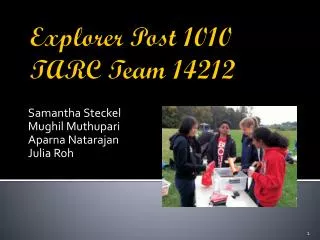
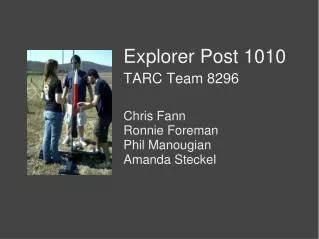
This project engaged team members in the design, implementation, and testing of a model rocket. Each individual contributed to different components including vehicles, payload, and safety devices through an egg drop challenge. The groups explored the essentials of rocket mechanics, electronics, and aerodynamics, culminating in a hands-on learning experience. Key elements included a visit to the wind tunnel, discussions on engine specifications, and performance predictions aimed at a target altitude of 300 meters. This program fostered teamwork and deepened understanding of aeronautical engineering.

Rocket Design and Testing: A Team Experience in Aeronautics
E N D
Presentation Transcript
Lets get started!!! • THEORY • DESIGN/ IMPLEMENT • TEST/CONFIRM
Team Work!!!! • Each person was put into individual groups to work on different components of the rocket • The groups were • Vehicles • Payload • Glider
EGG DROP!!! • DESIGNED, BUILT, AND TESTED EGG DROP SAFETY DEVICES
Astronaut • Mike Foreman
It’s electric!!! • Electronics package • Battery • Radio Transmitter • GPS Locater • Camera • Pitot tubes • Thermo Coupling Temperature Gauge
Take Flight! • Glider • Total Surface Area: 23.65623 square inches
Engine Required • Engine Size: F20-4W (EXX-7) • Mass: 140 grams • Impulse: 60.45 N(s)
Detailed Mass Info. • Nose Cone: 81 grams • Payload: 264.4 grams • Booster: 140 grams
Performance Predictions • The velocity of the rocket will be 76.68 m/s • The impulse will be 44.47 N(s) • The goal is to get the rocket 300 meters in the air
Conclusion • In conclusion this program has taught the post members to work as a team. • It was quite an experience to be able to learn about the mechanics that go into designing and building a rocket and theaeronautical concepts that goes into it.
Thank You!!! • Special thanks to: • Jinho Lee • Justin Gray • Jen klettlinger • Tom Benson • Mike Foreman • Giovanna E. Mignosa