Download
1 / 5
50 likes | 170 Vues
This presentation outlines the design and construction process of Team 8186's rocket for Project Explorer Post 1010. Utilizing a PNC-80k nose cone and F24-4W motor, the team crafted a BT80 body tube and custom fins, emphasizing teamwork throughout the build. Tools used included sandpaper, glue, and drills, while RocketSim provided design assistance. Key lessons from flight tests revealed the importance of weight distribution and time management in achieving stable flights. Our experience underlines the significance of mass adjustments in controlling rocket performance.

E N D
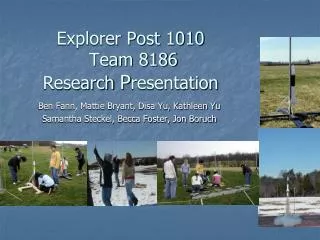
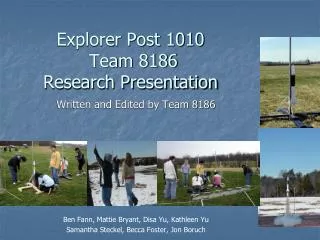
Explorer Post 1010 Team 8186 Research Presentation Written and Edited by Team 8186 Ben Fann, Mattie Bryant, Disa Yu, Kathleen Yu Samantha Steckel, Becca Foster, Jon Boruch
Design and Construction Process • We used a PNC-80k nose cone • Due to weight we used a F24-4W motor • We designed our own fins • BT80 body tube • We purchased three 70” x 7” • Rocket parts were chosen due to cost and supply • Rocket was built with tools such as sandpaper, glue, and drills • RocketSim Program was used as an aid in the design process
Teamwork • The team worked together on building the rocket. • Jon constructed the body tube • The construction of the egg compartment was mainly done by Disa, Ben and Mattie • The streamers were ironed and shaped by Samantha and Becca • Disa and Kathleen worked on the fins
Flight Testing Process • First fin design caused the rocket to spiral up. • First egg compartment was to heavy and had to be rebuilt Post 1010 Team 8186: Launch
Lessons learned • A weight concentration towards the center of the rocket will cause it to descend with a horizontal tilt, increasing flight time • Time is not to be underestimated • Flight inconsistency may be controlled by adjusting rocket’s mass