Understanding Stoichiometry in Acid-Base Reactions and Titrations
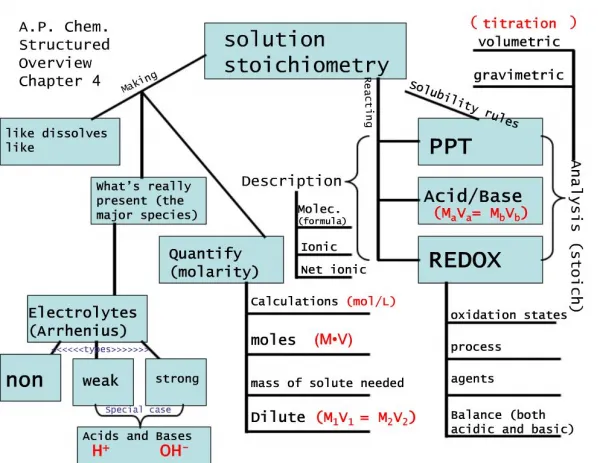
This guide explains the principles of stoichiometry as they apply to acid-base neutralization reactions, including calculations involving sodium hydroxide (NaOH) and sulfuric acid (H2SO4). It covers how to determine the volume of a sulfuric acid solution needed to neutralize a given mass of sodium hydroxide and how to find the mass of lead(II) nitrate consumed in a reaction with sodium iodide. The concept of titration is discussed, detailing how to find the concentration of an unknown solution using a standard solution and the importance of indicators in detecting the equivalence point.

Understanding Stoichiometry in Acid-Base Reactions and Titrations
E N D
Presentation Transcript
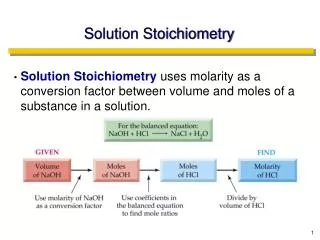
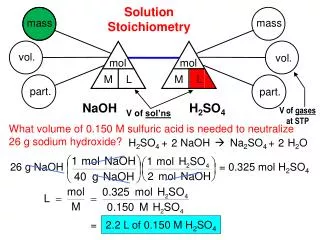
Solution Stoichiometry NaOH H2SO4 V of gases at STP V of sol’ns What volume of 0.150 M sulfuric acid is needed to neutralize 26 g sodium hydroxide? H2SO4 + NaOH Na2SO4 + H2O 2 2 26 g NaOH = 0.325 mol H2SO4 = 2.2 L of 0.150 M H2SO4 mass mass vol. vol. mol mol M L M L part. part.
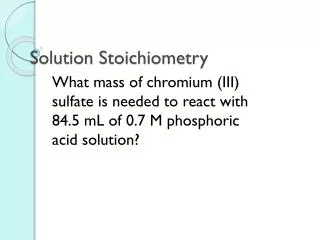
What mass of lead(II) nitrate will consume 85.0 mL of 0.45 M sodium iodide? 2 2 Pb(NO3)2 + NaI PbI2 + NaNO3 mol NaI = M L = 0.45 M (0.085 L ) = 0.03825 mol NaI Pb(NO3)2 NaI 0.03825 mol NaI = 6.3 g Pb(NO3)2
Titrations If we don’t know a solution’s concentration, we react a second solution of known concentration – called a standard solution–with the first. Based on the stoichiometryof the reaction, we can determine the unknown solution’s concentration. -- This procedure is called a titration.
The equivalence point of a titration occurs when stoichiometrically equivalent quantities are brought together. This point is identified by using indicators, which are chemicals whose color depends on the pH. A sudden color change indicates the end point of the titration, which coincides closely with the equivalence point, and is usually considered to be “good enough.”
If 56.0 mL of sodium hydroxide neutralize 19.0 mL of 0.235 M nitric acid, find the concentration of the base. mol H+ = mol OH– H+ + NO3– HNO3 0.235 M 0.235 M Na+ + OH– NaOH X M X M [ H+ ] VA = [ OH– ] VB 0.235 M (19.0 mL) [ OH– ] (56.0 mL) = = MNaOH = 0.0797 M NaOH [ OH– ]