Efficiency, Surplus and Doing Benefit-Cost Analysis
This project explores how economics can inform the optimal size of public projects and regulations through Benefit-Cost Analysis (CBA). By examining conflicts between sea otters and fisheries in Santa Barbara and Ventura Counties, the analysis quantifies the costs and benefits of various environmental policies. It highlights critical questions like emission standards, marine reserve sizes, and habitat protection for endangered species. The project aims to determine the best balance of consumer and producer surplus, making a case for comprehensive CBA in environmental decision-making.

Efficiency, Surplus and Doing Benefit-Cost Analysis
E N D
Presentation Transcript
Efficiency, Surplus and Doing Benefit-Cost Analysis How can economics help determine the optimal size of a project or extent of a regulation?
Motivating Group Project 2001 Actual Group Project (Advisors—Profs. McAusland and Kendall): A Cost-Benefit Analysis of Public Law 99-625: Sea Otter-Shellfishery Conflicts in Santa Barbara and Ventura Counties 2001 Actual Group Project (Advisors—Profs. McAusland and Kendall): A Cost-Benefit Analysis of Public Law 99-625: Sea Otter-Shellfishery Conflicts in Santa Barbara and Ventura Counties 2001 Actual Group Project (Advisors—Profs. McAusland and Kendall): A Cost-Benefit Analysis of Public Law 99-625: Sea Otter-Shellfishery Conflicts in Santa Barbara and Ventura Counties
A few other examples • What should be the CO concentration standard in tailpipe emissions? • What is the appropriate level of GHG emission reduction worldwide? • How large should the Channel Islands marine reserve be? • Can we measure loss to recreationists of the Forest Adventure Pass? • Add another lane to Hwy 101? • Close Mission Canyon to cyclists? • What habitat to buy to protect endangered species (eg, Least Bell’s Vireo – bird)
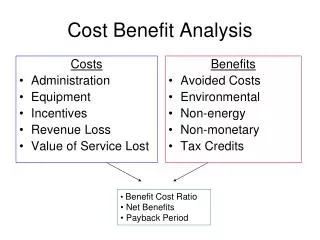
Generic Problem • Characterize an Environmental Policy or Action (or multiple policies or actions) • Estimate the Consequences of that policy or action • Estimate the pluses (benefits) and minuses (costs) of that policy or action • Reach conclusions
CBA: main principle • Quantify all costs and benefits in a common measure (usually $) • Common metric need not be $ • eg, health- health analysis, with health as metric • Benefits directly measured in terms of lives saved • Costs indirect: costs increase deaths since • Regs make people poorer • lower incomes lead to higher mortality ($13 million in extra costs results in 1 statistical death) • Eg, Compare risks in lower and higher income countries • Compare projects based on net effects on health.
What others method to use? • Cost-effectiveness Analysis • Weighted cost-benefit analysis • Multigoal analysis
Basic measure of value is willingness-to-pay • Demand curve is marginal willingness to pay MWTP First units very valuable Last units less valuable Quantity of water
Consumers Surplus (CS) $ CS(q) p D(x) x q
Calculating benefitsfrom MWTP • Demand, D(x), measures MB. • Consumers Surplus is the total benefit to consumers minus their cost.
Example – gross value of water from new dam (excluding costs) Price New dam . . . . . . . . . . . . . . .. . . . . . . . . Demand for water Add’l Value Acre-feet of water
What about nonmarket goods? Suppose there were a market: Price Demand for air quality Air quality BUT, NO MARKET: price similar to MWTP
Environmental goods • Demand for env goods just as real as demand for market goods – just harder to measure • Demand is a measure of intensity of preferences
Costs are simpler • Some units are cheap to produce • “Marginal” units are most expensive • Costs consist of • Fixed costs • Marginal costs
Marginal costs plus fixed costs add up to total costs Last units pricey MC First units cheapest Quantity
Producer Surplus (PS) $ MC(x) PS(q) p x q
How are costs calculated? • Supply, S(x), is same thing as MC. • Producer Surplus is the total revenue to producers minus their cost.
Put it together P Total Surplus . . . . . . . . . . . . . . . . . . . . . . . . . . . . . . . . . . . . . . . . . . . . . . . . . . . . . . . . . . . . . . Q
Where is CS+PS maximized? $ Tension: Too little produced At too high price. CS low, PS high CS p Supply, S(x) PS Demand, D(x) x q1 q*
Suppose goods supplied in fixed amount Price Supply of land Consumer surplus Producer surplus (goes to land owners) Market Price Demand for land Land
Example: Add a dam Status quo water availability Price PS: Before: # and X After: CS: ?? ################## XXXXXXXXXXXX Q Water
Example: Add a dam Supply of water increases; price falls. What happens to PS? CS? Price PS: Before: # and X After: X and $ CS: ?? ################## XXXXXXXXXXXX $$$$$ Q Water
If captured all costs & benefits • Then we want to maximize CS + PS which would occur where Supply = Demand. • Challenge is to capture all costs and benefits to accurately measure MC & MB.
Costs come in different flavors:Private, external and social • In principle, need to capture all costs and benefits. • Social costs may exceed private costs. • Difference is the “external cost” – the monetized cost of the externality. $/gal MPC P0 Q0 Gallons Of Gasoline
Social vs. Private Costs • In principle, need to capture all costs and benefits. • Social costs may exceed private costs. • Difference is the “external cost” – the monetized cost of the externality. $/gal MPC P0 MEC Q0 Gallons Of Gasoline
Social vs. Private Costs • In principle, need to capture all costs and benefits. • Social costs may exceed private costs. • Difference is the “external cost” – the monetized cost of the externality. $/gal MSC P* MPC P0 MEC Q0 Q* Gallons Of Gasoline
First Theorem of Welfare Economics • In a competitive market • Surplus is maximized at a market equilibrium • Implications • Can rely on market if we are sure of competitive market
Implicit Assumptions: Distribution • Distributional consequences ignored • Compensation Principle
Implicit Assumptions: Income Price Y=$50,000 per year Y=$30,000 per year Restaurant meals Demand and thus surplus depend on income distribution Therefore: Change in income distribution will change results of CBA TO USE CBA, MUST BELIEVE INCOME DISTRIBUTION IS OK
Implicit Assumptions: Completeness • What happens with difficult to monetize benefits? • Eg, clear view of Santa Cruz Islands • Difficult to monetize benes often omitted • Results in bias against env. benes
Implicit Assumptions: Other • Moral and political dimensions omitted • Should we do a cost-benefit analysis on executing someone who has committed a crime? • Are there other issues when lives are at stake? • Are intergenerational issues adequately treated by CBA?
Ten Steps to doing and using a CBA • Decide whose benefits and costs count • Select the portfolio of alternative projects • Catalog potential physical impacts and determine how they are measured • Predict quantitative physical impacts over life of project • Monetize all impacts • Discount for time to find present values • Sum: add up all benefits and costs • Perform sensitivity analysis • Choose alternative with largest social benefits • Make policy recommendation, using CBA only as part of guidance