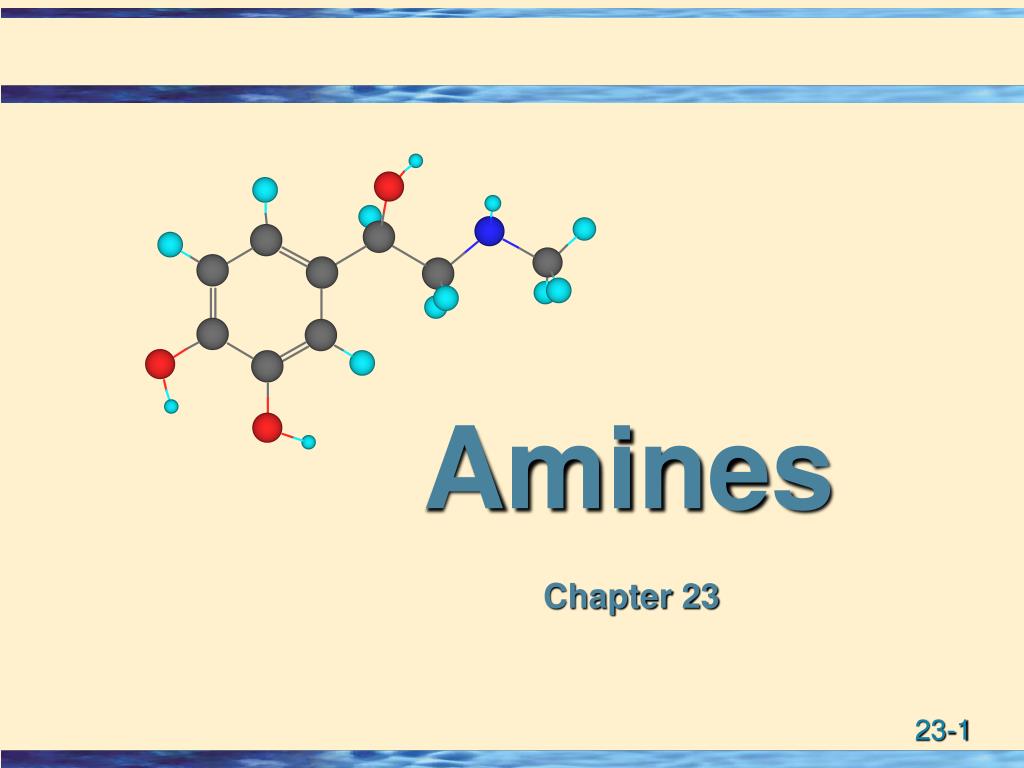
Amines. Chapter 23. Structure & Classification. Amines are classified as: 1°, 2°, or , 3° amines: Amines in which there are 1, 2, or 3 alkyl or aryl groups. Structure & Classification. Amines are further divided into aliphatic, aromatic, and heterocyclic amines:
Une image / un lien ci-dessous est fourni (tel quel) pour télécharger la présentation
Politique de téléchargement : le contenu du site vous est fourni TEL QUEL pour votre information et votre usage personnel ; il ne peut être vendu, concédé sous licence ni partagé sur d’autres sites sans l’accord de son auteur.Le contenu vous est fourni TEL QUEL, pour votre information et votre usage personnel uniquement.Téléchargez la présentation en cliquant sur ce lien.Lors du téléchargement, si vous ne parvenez pas à télécharger une présentation, l’éditeur a peut-être supprimé le fichier de son serveur.Pendant le téléchargement, si vous ne parvenez pas à obtenir une présentation, le fichier a peut-être été supprimé par l’éditeur.
Structure & Classification • Amines are classified as: • 1°, 2°, or , 3° amines: Amines in which there are 1, 2, or 3 alkyl or aryl groups.
Structure & Classification • Amines are further divided into aliphatic, aromatic, and heterocyclic amines: • Aliphaticamine: An amine in which nitrogen is bonded only to alkyl groups. • Aromatic amine: An amine in which nitrogen is bonded to one or more aryl groups.
Structure & Classification • Heterocyclic amine: An amine in which nitrogen is one of the atoms of a ring.
Nomenclature • Aliphatic amines: replace the suffix -e of the parent alkane by -amine.
Nomenclature • The IUPAC system retains the name aniline.
Nomenclature • Among the various functional groups, -NH2 is one of the lowest in order of precedence. Amine vs alcohol Amine vs acid
Nomenclature • Common names for most aliphatic amines are derived by listing the alkyl groups bonded to nitrogen in one word ending with the suffix -amine.
Nomenclature • When four groups are bonded to nitrogen, the compound is named as a salt of the corresponding amine.
Chirality of Amines • Consider the unshared pair of electrons on nitrogen as a fourth group, then the arrangement of groups around N is approximately tetrahedral. • An amine with three different groups bonded to N is chiral and exists as a pair of enantiomers and, in principle, can be resolved.
Chirality of Amines • In practice, however, they cannot be resolved because they undergo inversion, which converts one enantiomer to the other.
Chirality of Amines • Pyramidal inversion is not possible with quaternary ammonium ions, and their salts can be resolved.
Physical Properties • Amines are polar compounds, and both 1° and 2° amines form intermolecular hydrogen bonds. • N-H- - -N hydrogen bonds are weaker than O-H- - -O hydrogen bonds because the difference in electronegativity between N and H (3.0 - 2.1 =0.9) is less than that between O and H (3.5 - 2.1 = 1.4). Using bp as an indication of H bonding Increasing strength
Basicity • All amines are weak bases, and aqueous solutions of amines are basic. • It is common to discuss their basicity by reference to the acid ionization constant of the conjugate acid.
Basicity • Using values of pKa, we can compare the acidities of amine conjugate acids with other acids.
Basicity-Aromatic Amines • Aromatic amines are weaker bases than aliphatic amines because of two factors: • Resonance stabilization of the free base, which is lost on protonation.
Basicity-Aromatic Amines • The greater electron-withdrawing inductive effect of the sp2-hybridized carbon of an aromatic amine compared with that of the sp3-hybridized carbon of an aliphatic amine. And note the effect of substituents • Electron-releasing groups, such as alkyl groups, increase the basicity of aromatic amines. • Electron-withdrawing groups, such as halogens, the nitro group, and a carbonyl group decrease the basicity of aromatic amines by a combination of resonance and inductive effects.
Example: Basicity-Aromatic Amines 3-nitroaniline is a stronger base than 4-Nitroaniline. Cannot do this kind of resonance in 3 nitroaniline
Basicity-Aromatic Amines • Heterocyclic aromatic amines are weaker bases than heterocyclic aliphatic amines.
Basicity-Aromatic Amines • In pyridine, the unshared pair of electrons on N is not part of the aromatic sextet. • Pyridine is a weaker base than heterocyclic aliphatic amines because the free electron pair on N lies in an sp2 hybrid orbital (33% s character) and is held more tightly to the nucleus than the free electron pair on N in an sp3 hybrid orbital (25% s character).
Basicity-Aromatic Amines • Imidazole Which N lone pair is protonated? The one which is not part of the aromatic system.
Basicity-Guanidine • Guanidine is the strongest base among neutral organic compounds. • Its basicity is due to the delocalization of the positive charge over the three nitrogen atoms.
Reaction with Acids • All amines, whether soluble or insoluble in water, react quantitatively with strong acids to form water-soluble salts.
Reaction with acids • Separation and purification of an amine and a neutral compound.
Preparation • We have already covered these methods • nucleophilic ring opening of epoxides by ammonia and amines. • addition of nitrogen nucleophiles to aldehydes and ketones to form imines • reduction of imines to amines • reduction of amides to amines by LiAlH4 • reduction of nitriles to a 1° amine • nitration of arenes followed by reduction of the NO2 group to a 1° amine
Preparation • Alkylation of ammonia and amines by SN2 substitution. • Unfortunately, such alkylations give mixtures of products through a series of proton transfer and nucleophilic substitution reactions. polyalkylations
Reaction with HNO2 • Nitrous acid, a weak acid, is most commonly prepared by treating NaNO2 with aqueous H2SO4 or HCl. • In its reactions with amines, nitrous acid: • Participates in proton-transfer reactions. • A source of the nitrosyl cation, NO+, a weak electrophile.
Reaction with HNO2 • NO+ is formed in the following way. • Step 1: Protonation of HONO. • Step 2: Loss of H2O. • We study the reactions of HNO2 with 1°, 2°, and 3° aliphatic and aromatic amines.
Tertiary Amines with HNO2 • 3° Aliphatic amines, whether water-soluble or water-insoluble, are protonated to form water-soluble salts. • 3° Aromatic amines: NO+ is a weak electrophile and participates in Electrophilic Aromatic Substitution.
Secondary Amines with HNO2 • 2° Aliphatic and aromatic amines react with NO+ to give N-nitrosamines. carcinogens Mechanism:
RNH2 with HNO2 • 1° aliphatic amines give a mixture of unrearranged and rearranged substitution and elimination products, all of which are produced by way of a diazonium ion and its loss of N2 to give a carbocation. • Diazonium ion: An RN2+ or ArN2+ ion
1° RNH2 with HNO2 • Formation of a diazonium ion. Step 1: Reaction of a 1° amine with the nitrosyl cation. Step 2: Protonation followed by loss of water.
1° RNH2 with HNO2 (Aliphatic) • Aliphatic diazonium ions are unstable and lose N2 to give a carbocation which may: 1. Lose a proton to give an alkene. 2. React with a nucleophile to give a substitution product. 3. Rearrange and then react by Steps 1 and/or 2.
1° RNH2 with HNO2 • Tiffeneau-Demjanov reaction: Treatment of a -aminoalcohol with HNO2 gives a ketone and N2.
Mechanism of Tiffeneau-Demjanov • Reaction with NO+ gives a diazonium ion. • Concerted loss of N2 and rearrangement followed by proton transfer gives the ketone. Similar to pinacol rearrangement
Mechanism Reversible protonation. Elimination of water to yield tertiary carbocation. This is a protonated ketone! 1,2 rearrangement to yield resonance stabilized cation. Deprotonation.
Hofmann Elimination • Hofmann elimination: Thermal decomposition of a quaternary ammonium hydroxide to give an alkene. • Step 1: Formation of a 4° ammonium hydroxide.
Hofmann Elimination • Step 2: Thermal decomposition of the 4° ammonium hydroxide.
Hofmann Elimination • Hofmann elimination is regioselective - the major product is the least substituted alkene. • Hofmann’s rule:Any -elimination that occurs preferentially to give the least substituted alkene as the major product is said to follow Hofmann’s rule.
Hofmann Elimination • The regioselectivity of Hofmann elimination is determined largely by steric factors, namely the bulk of the -NR3+ group. • Hydroxide ion preferentially approaches and removes the least hindered hydrogen and, thus, gives the least substituted alkene. • Bulky bases such as (CH3)3CO-K+ give largely Hofmann elimination with haloalkanes.
Connexion au compte
Connectez-vous pour publier votre contenu sur SlideServe.