
SlideServe
Menu
Préférences
© SlideServe · v2026

Amines

habib avatar
4 diapositives · 1.4K Views · Oct 09, 2014

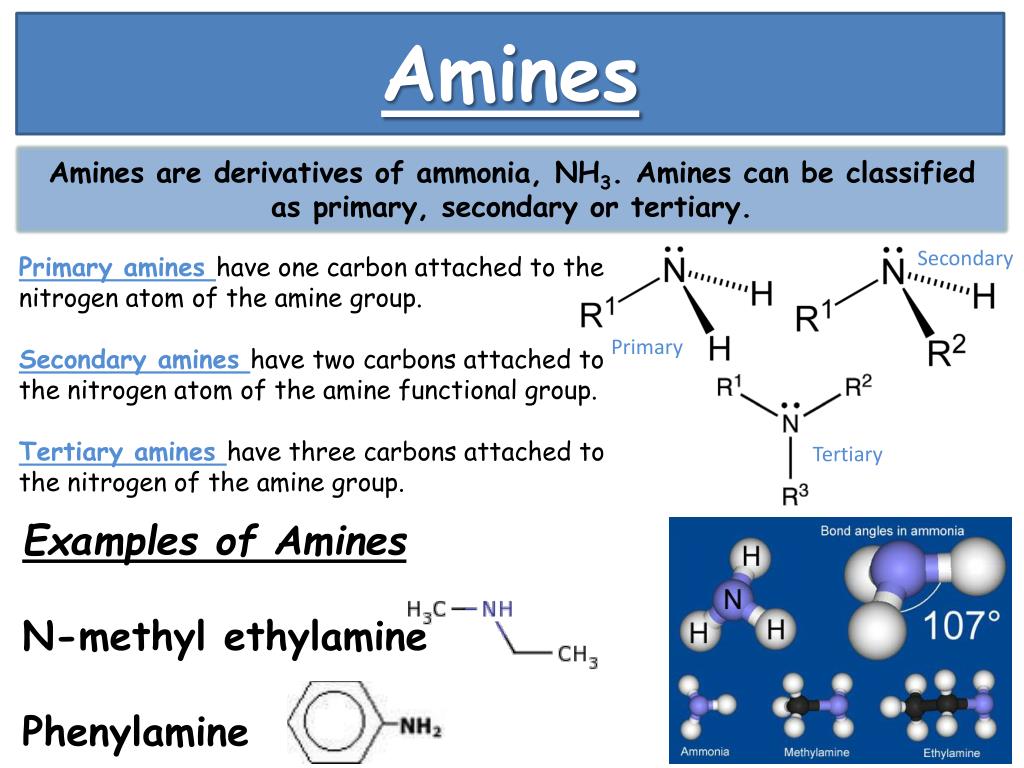
Amines are derivatives of ammonia, NH 3 . Amines can be classified as primary, secondary or tertiary. Amines. Secondary. Primary amines have one carbon attached to the nitrogen atom of the amine group.
Amines - slide 1
01 / 4Amines
1 / 17

Télécharger la présentation

Amines
Une image / un lien ci-dessous est fourni (tel quel) pour télécharger la présentation

Politique de téléchargement : le contenu du site vous est fourni TEL QUEL pour votre information et votre usage personnel ; il ne peut être vendu, concédé sous licence ni partagé sur d’autres sites sans l’accord de son auteur.Le contenu vous est fourni TEL QUEL, pour votre information et votre usage personnel uniquement. Téléchargez la présentation en cliquant sur ce lien. Lors du téléchargement, si vous ne parvenez pas à télécharger une présentation, l’éditeur a peut-être supprimé le fichier de son serveur.Pendant le téléchargement, si vous ne parvenez pas à obtenir une présentation, le fichier a peut-être été supprimé par l’éditeur.

F I N

Plus de contenu associé

Transcription de la présentation
  1. Amines are derivatives of ammonia, NH3. Amines can be classified as primary, secondary or tertiary. Amines Secondary Primary amines have one carbon attached to the nitrogen atom of the amine group. Secondary amines have two carbons attached to the nitrogen atom of the amine functional group. Tertiary amines have three carbons attached to the nitrogen of the amine group. Primary Tertiary Examples of Amines N-methyl ethylamine Phenylamine

  2. Basicity of Amines Amines are weak bases – they are proton acceptors. Amines have a lone pair of electrons on the nitrogen atom. This lone pair can form a dative covalent bond with a proton. The positive charge is localised to the nitrogen atom. H+ Acid + Amine  Ammonium Salt Ethylamine + Methanoic Acid  Ethylammonium methanoate Phenylamine + Sulphuric Acid  Phenylammoniumsulfate

  3. Preparation of Aliphatic Amines Aliphatic amines are non-cyclic. They are produced by the substitution of halogenoalkanes with excess ethanolic ammonia. The mechanism is nucleophilic substitution. Halogenoalkane + Ammonia  Amine + Hydrogen halide + HCl :Cl- Chloromethane + Ammonia  Methylamine + Hydrogen Chloride Conditions:Warm excess ethanolic ammonia. Ethanol is used as the solvent because if water was used, we could get hydrolysis of the Halogenoalkane to produce an alcohol. The disadvantage of this method of amine production is that the primary amine formed has a lone pair of electrons and can itself act as a nucleophile. Further substitution can occur to form a secondary amine. This is avoided by using excess ammonia – excess ammonia will react with the HCl formed : HCl + NH3 NH4+Cl- Overall, this gives: CH3Cl + 2NH3  CH3NH2 + NH4+Cl-

  4. Preparation of Aromatic Amines Aromatic amines are formed by the reduction of nitrobenzene, in the presence of concentrated HCl and Sn. + 6[H] + 2H2O Synthesis of Azo Dyes Diazotisation– aromatic amine transformed to diazonium salt. Conditions: Below 10°; NaNO2 ; Excess HCl. The NaNO2 and HCl react to form nitrous acid, HNO2, in situ. Coupling reaction with phenol – diazonium salt is coupled with a phenolic compound under alkaline conditions. The benzene rings are linked together through an azo (N=N) functional group. NaNO2 + HCl HNO2 + NaCl Under alkaline conditions, so the HCl formed reacts with the NaOH to form sodium chloride + water: NaOH + HCl NaCl + H2O