Understanding Catalysis: Nobel Prize Insights and Reactions
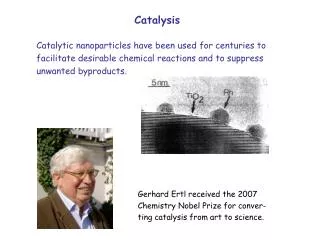
This lecture focuses on the fundamentals of catalysis, including the roles of catalysts and their mechanisms, following the 2007 Nobel Prize in Chemistry. It explores key concepts such as active sites, adsorption, and surface reactions, emphasizing the importance of catalysts in industrial processes, which contribute significantly to the U.S. gross national product. The discussion includes catalytic reforming, octane numbers, and the rate-limiting steps in catalytic reactions. This comprehensive overview is essential for anyone interested in the science of chemical reactions and industrial applications.

Understanding Catalysis: Nobel Prize Insights and Reactions
E N D
Presentation Transcript
Lecture 23 Thursday 4/1/08OCNB ExplosionNoble Prize 2007Catalytic Steps
400 Temperature oC Cooling Restored Qr = 0 Isothermal Operation 200 175 9:55 t = 0 10:40 10:50 midnight 12:18 Temperature-time trajectory fuse
Catalysts and Catalysis A Catalyst is a substance that affects the rate of chemical reaction but emerges from the process unchanged. Catalysis is the occurrence, study, and use of catalysts and catalytic processes. Approximately 1/3 of the GNP of materials produced in the U.S. involves a catalytic process.
Active Site • Reactions are not catalyzed over the entire surface but only at certain active sites or centers that result from unsaturated atoms in the surface. • An active site is a point on the surface that can form strong chemical bonds with an adsorbed atom or molecule.
The Rate Limiting Step:Which Step Has the Largest Resistance?
Octane Numbers Catalytic Reforming Normal Pentane Octane Number = 62 Iso-Pentane Octane Number = 95
Intro to Catalysis • Reforming catalyst – • Algorithm • Postulate a mechanism • Postulate a rate-limiting step • Express Ci·s in terms of partial pressures • Site balance (Total number of sites constant) • Derive rate law • Evaluate parameters Pt (sputtered on) Al2O5 (scaffold)
CV=concentration of vacant sites Postulate a mechanism: (single site) In 75% of heterogeneous catalysis, surface reaction is the slow step
Site Balance: Is this consistent with the data? Linear when PNi0 is low Low slope when PNi0 is large rNi0 PNi0 Consistent!!