Understanding Decision Trees: Concepts, Types, Advantages, and Applications
This article explores the fundamentals of decision trees, which are rooted trees used for decision-making. It describes their structure, including the role of the root, internal vertices, and leaves. Key elements such as decision sets, possible outcomes, and probabilities are discussed, leading to optimal solutions for various problems. The article outlines different types of decision trees, including classification and regression trees, and highlights their advantages, such as simplicity and interpretability. Real-world applications, including project management and bidding scenarios, are showcased to illustrate decision tree advantages in practice.

Understanding Decision Trees: Concepts, Types, Advantages, and Applications
E N D
Presentation Transcript
DecisionTrees Daisy Guevara Gilberto Jiménez Orlando Ruiz Jan Salomón
What is a rooted tree? • It is a tree in which one vertex has been designated as the root and every edge is directed away from the root.
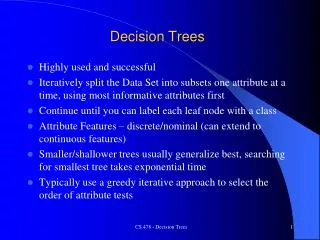
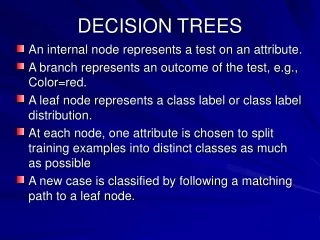
What are decision trees? • It is a rooted tree in which internal vertex correspond to a decision, with a sub-tree at these vertices for each possible outcome of the decision. • The possible solution of the problem correspond to the paths to the leaves of this rooted tree.
Elements of a Decision Tree • The set of decision (or strategies) • The set of possible outcomes and/or the probabilities of these outcomes. • The results for the various combination and outcomes. Once these elements are known, it is possible to find the “optimal” solution or decision of the problem.
Types of Decision Trees • Decision Tree Forests
Types of Decision Trees • Classification and Regression Trees
Types of Decision Trees • Binary Survival Tree
Advantages of Decision Trees • Are simple to understand and interpret. • Have value even with little hard data. Important insights can be generated based on experts describing a situation (its alternatives, probabilities, and costs) and their preferences for outcomes. • Possible scenarios can be added • Worst, best and expected values can be determined for different scenarios. • Can be combined with other decision techniques.
Example: An application of decision trees in Project Management • A company named SciTools Incorporated, is invited to make a bid on a government contract. The company with the lower bid obtain the contract. • The cost of prepared a bid is the $5,000. • The cost of the project is $95,000. • The total cost for the company is $100,000. Then, to obtain gain the company has to bid an amount greater than $100,000.
The third decision is consider if there will be other competitors in the bid?
The company, based on previous experience believes there is a 30% chance that there will be no competing bids.
The fourth decision is to consider the probability to win the bid.
Example of Heads or Tails • Two persons enter in a bid of whom will obtain two heads or two tails. The options are presented in the following decision tree:
Example of Dinner’s Dilemma A group of friends go out to dinner. They decided before arriving to the restaurant to share the bill. They are expecting to eat better and cheaper than paying individually.