
SlideServe
Menu
Préférences
© SlideServe · v2026

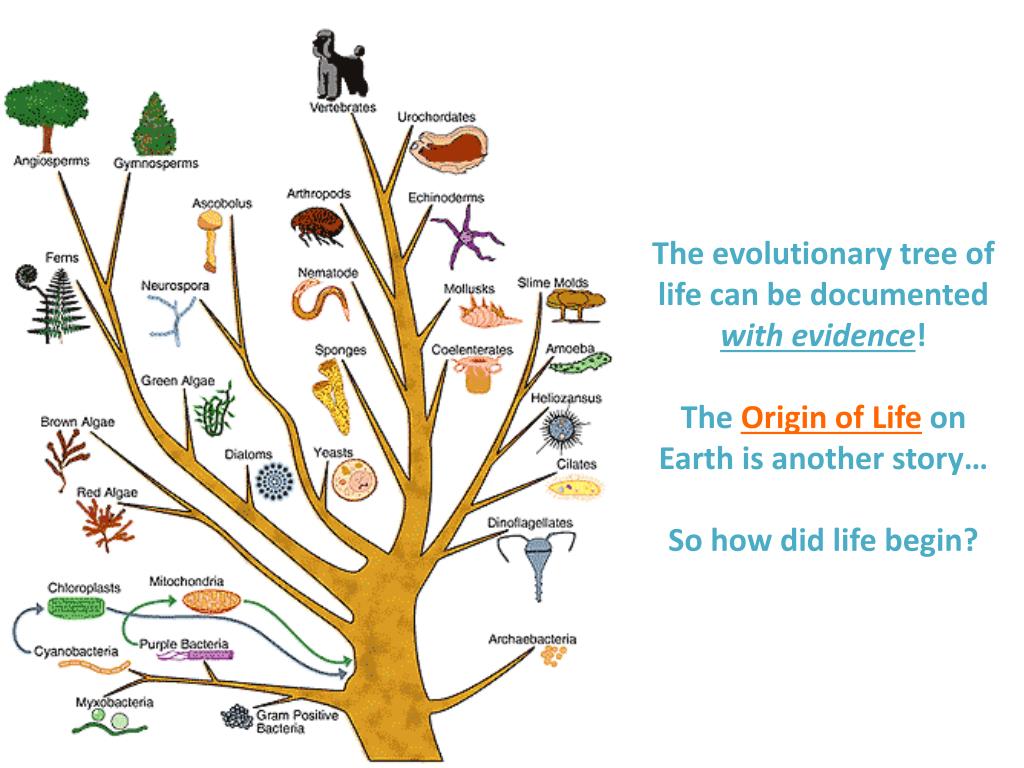
The evolutionary tree of life can be documented with evidence !

alima avatar
22 diapositives · 2.1K Views · Aug 02, 2014

The evolutionary tree of life can be documented with evidence ! The Origin of Life on Earth is another story… So how did life begin?. The Origin of Life. First, what is life?. Made of cells Respond to the environment Maintain homeostasis Uses energy Grows & develops Reproduces
The evolutionary tree of life can be documented with evidence ! - slide 1
01 / 22The evolutionary tree of life can be documented with evidence !
1 / 17

Télécharger la présentation

The evolutionary tree of life can be documented with evidence !
Une image / un lien ci-dessous est fourni (tel quel) pour télécharger la présentation

Politique de téléchargement : le contenu du site vous est fourni TEL QUEL pour votre information et votre usage personnel ; il ne peut être vendu, concédé sous licence ni partagé sur d’autres sites sans l’accord de son auteur.Le contenu vous est fourni TEL QUEL, pour votre information et votre usage personnel uniquement. Téléchargez la présentation en cliquant sur ce lien. Lors du téléchargement, si vous ne parvenez pas à télécharger une présentation, l’éditeur a peut-être supprimé le fichier de son serveur.Pendant le téléchargement, si vous ne parvenez pas à obtenir une présentation, le fichier a peut-être été supprimé par l’éditeur.

F I N

Plus de contenu associé

Transcription de la présentation
  1. The evolutionary tree of life can be documented with evidence! The Origin of Life on Earth is another story… So how did life begin?

  2. The Origin of Life

  3. First, what is life? • Made of cells • Respond to the environment • Maintain homeostasis • Uses energy • Grows & develops • Reproduces • DNA/RNA • Evolves Remember that all life is made of the 4 macromolecules (organic compounds)!

  4. The Origin of Life is a Hypothesis! • Biogenesis – macromolecules were created without oxygen & bacteria & other cells evolved from these macromolecules • Testable

  5. In order to test this, we need to know what early Earth was like! • Reducing Atmosphere • Hydrogen, methane, ammonia, water • Lots of available hydrogen & its electrons • No free oxygen! • Energy Sources: lightening, UV radiation, & volcanoes What’s missing?!

  6. The Creation of Organic Molecules • In the 1920s, AleksandrOparin & John Haldane proposed that early Earth had a reducing atmosphere (no oxygen) & that it was possible for organic molecules for form in those conditions. • In 1953, Stanley Miller & Harold Urey tested this hypothesis.

  7. The Miller-Urey Experiment • They found that the gases available in a reducing atmosphere could be rearranged to form: • Amino Acids • Hydrocarbons • Nitrogen Bases • Other Organics

  8. In conclusion… • The Miller-Urey experiment proved that even with harsh conditions on Earth, it was still possible for organic molecules to form! • Remember!All life is made of organic molecules (proteins, lipids, carbohydrates, nucleic acids). • Life is only possible if organic molecules exist! Okay, so we have organic molecules… is that the origin of life? NO! The origin of life is marked by the formation of Earth’s first cell…

  9. The Origin of Cells • Starts with bubbles called coacervates – separates the inside from the outside & allows metabolism & reproduction to occur

  10. Key Events in the Origin of Life • Life originated 3.5-4.0 billion years ago! What came first: prokaryotic cells or eukaryotic cells?

  11. Prokaryotes • Prokaryotes dominated life on Earth from 3.5-2.0 bya! • The 1st actual cells 3.5 billion year old fossil of bacteria Modern bacteria Chains of unicellular cyanobacteria

  12. Oxygen in the Atmosphere • Oxygen began to accumulate 2.7 bya. • Reducing  Oxidizing Atmosphere • Evidence in banded iron in rocks – rusting • Makes aerobic respiration possible!

  13. The 1st Eukaryotes (~2 bya) • Started with the development of internal membranes • Created internal micro-environments • Advantage: specialization (increased efficiency)

  14. Evolution of Eukaryotes via Endosymbiosis • An ancestral bacterial cell engulfed another bacterial cell, but did not digest it! • Mutually beneficial relationship (which led to NS) • Origin of mitochondria & chloroplasts

  15. Questions? Is there life outside of Earth? Does it look like the life on Earth?

  16. Patterns of Evolution

  17. Increasing Complexity of Cellular Life • The rise of oxygen in the atmosphere drove some life forms to extinction, while other life forms evolved new, more efficient metabolic pathways that use oxygen for respiration.

  18. Extinction • 99% of all species that have ever lived are now extinct! • In the struggle for existence, species compete for resources, & some lose. • Sudden changes in the environment or natural disasters can cause mass extinctions. • A mass extinction allows for a new radiation of species to fill all the empty niches. The Dodo Bird has been extinct for several hundred years after humans introduced predators into their habitat.

  19. Adaptive Radiation • Several vastly different species arise from a single species to fill available niches.

  20. Convergent Evolution • Unrelated organisms come to resemble each other, because their adaptations resemble each other. Penguins (birds) & dolphins (mammals) have modified structures that are like a fish for swimming! Remember?! Analogous Structures?!

  21. Coevolution • 2 species evolve along with each other based on a close relationship with each other. Many plants have coevolved with their pollinators & now can only be pollinated by 1 species!

  22. Punctuated Equilibrium • Long periods of time with stable species broken with rapid period of change