Download

1 / 21
210 likes | 364 Vues
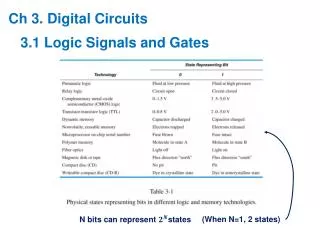
This course provides an overview of essential digital logic concepts, covering topics such as gates, truth tables, Boolean algebra, and complex logic circuits. Students will learn about combinational logic systems, clocking, memory elements, and basic digital components like multiplexers and decoders. The curriculum emphasizes practical applications of Boolean laws and circuit design techniques, including step-by-step construction of truth tables and logic equations in sum-of-products form. Gain a solid foundation in digital logic, paving the way for advanced studies in computer organization.

E N D
CDA 3101 Fall 2013Introduction to Computer Organization Digital Logic “102” 26 August 2013 Mark Schmalz http://www.cise.ufl.edu/~mssz/CompOrg/Top-Level.html
Overview • Review of gates and truth tables • Boolean algebra • Complex logic circuits • Combinational logic systems • Clocking • Memory elements
Transistors Symbol Functional Behavior NOT gate (Inverter)
Gate Symbol Truth Table NOT Gate NAND Gate
Boolean Algebra • Basic operators: OR (sum), AND (product), NOT • Boolean laws:
M = ABC + ABC + ABC + ABC The Majority Function M = f (A, B, C)
M = ABC + ABC + ABC + ABC The Majority Function (cont’d) M = f (A, B, C) Step 1. Build truth table for logic function f. Step 2. Write logic equation in SOP form. 3b 1 1 0 3a Step 3.a) Build SOP circuit using minterms (M=1); b) OR minterms
Combinatorial Logic • Many inputs and many outputs • Outputs are uniquely determined by inputs • Absence of memory elements • Basic combinatorial circuits • Multiplexers • Demultiplexers • Decoders • Comparators
Multiplexer 2n data inputs 1 data output n control inputs
Decoder n data inputs 2n data outputs 3-to-8 decoder
Two-Level Logic PLA 12 inputs 6 outputs x
Clocks Clock period
Edge-Triggered Clocking State Element 1 State Element 2 Combinational logic State Element Combinational logic
NOR SR Latch State 0 State 1 S - set Inputs Outputs: Q and Q R - reset
Clocked D Latch D C Q
D flip-flop D D Q D Q Q D latch D latch Q C C Q C Setup time D hold time C Q
Conclusions • Digital logic – lowest level of CDA3101 worldview • Digital logic circuits • Made from building blocks (AND,OR,NOT,…) • Simple or Complex, Combinatorial • Synchronous (clocked) or Asynchronous • Know rules for Boolean Algebra Enjoy your week!!