Download
1 / 12
120 likes | 228 Vues
This document outlines the heat treating process for fibers used in the Tagger microscope, focusing on key techniques such as preheating, bending, and splicing. It discusses the design of a bending unit meant for overnight use, allowing for preparation in the morning. The setup includes a controlled heating process, insulation to minimize ambient losses, and features to ensure safe and effective bending. Prototyping insights contrast various versions of the equipment, enhancing understanding of efficiency and usability in a research context.

E N D
Heat Treating Fibers for the Tagger Microscope J. McIntyre, March19, 2012
Why? J. McIntyre, March19, 2012
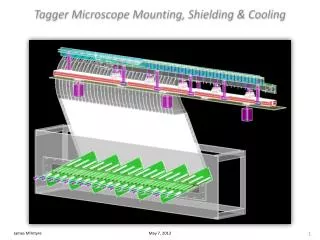
Tagger Microscope Enclosure J. McIntyre, March19, 2012
Prototype Version J. McIntyre, March19, 2012
Straightening J. McIntyre, March19, 2012
Fiber Splicing J. McIntyre, March19, 2012
Preheating J. McIntyre, March19, 2012
Preheat Setup No Water Water No Water 1200 Watt Heater J. McIntyre, March19, 2012
Bending Start Preheat Fibers then bend Finish J. McIntyre, March19, 2012
Prototype vs. Full Scale Bending J. McIntyre, March19, 2012 Water
Summary • Bending unit is designed for over night use: • Workers can use the morning to prepare a fiber bundle • Once preheated and set in position, electronics will control a gradual heat up of the fibers and secure the heater when the desired temperature is achieved. • Ambient losses will allow gradual cooling overnight so that workers can remove the bent bundle in the morning. • Foam insulation will completely surround the bending setup to control ambient losses to a manageable level. J. McIntyre, March19, 2012
Tagger Microscope Enclosure Heat Treating Unit J. McIntyre, March19, 2012