Exploring Potential Energy and Voltage Changes Due to Point Charges
This lecture delves into the concepts of potential energy (ΔU) and voltage (ΔV) changes as one navigates the electric field created by a point charge. We analyze the energy required for an object to ascend a potential hill from infinity to a given point, illustrated by examples involving a uniformly charged plastic shell. The effects of varying charge distributions, such as dipoles and different configuration shapes, are examined, highlighting the significance of these factors on the electric field (E) and potential difference (ΔV) in a system.

Exploring Potential Energy and Voltage Changes Due to Point Charges
E N D
Presentation Transcript
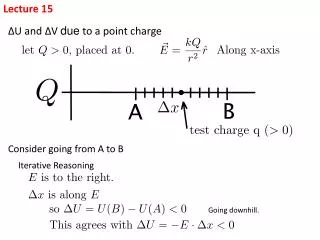
Lecture 15 ΔU and ΔV due to a point charge Consider going from A to B Iterative Reasoning Going downhill.
ΔU and ΔV due to a point charge continued... Math: here
Point Charge Q Where work from infinity to r is energy required in climbing the potential hill Q
Fig(clicker) 15.1 180° General Case:
Fig(clicker) 15.2 Region 1 -6 0 Region 2 Region 3 +12 +6
Ch17. Hw2:001-003 continued... Clicker 17-h2:1-3 What is the sign of V(R) – v(r)?
N-dependence of ΔV For dipole: point charge: long rod: solid rod: The curves of E vs. x for different N’s are shown in the figure. Notice at r = 1, E = k, independent of N. In going from N = -3 to N = -1, the peak at x = 0 becomes less and less pronounced. At N = +1, the peak turns into a valley. Lesson: The shape of E vs. x curve is sensitive to the power of N.