

SlideServe
Menu
Préférences
© SlideServe · v2026

Chapter 41: Fishes

alyn avatar
151 diapositives · 1.9K Views · Oct 09, 2014

Chapter 41: Fishes. 41-1 Introduction to Vertebrates. 41-2 Jawless Fishes, Sharks, and Rays. 41-3 Bony Fishes. 41-1 Introduction to Vertebrates. I. Characteristics of Vertebrates (evolved ~ 550 m.y.a.).
Chapter 41: Fishes - slide 1
01 / 151Chapter 41: Fishes
1 / 17

Télécharger la présentation

Chapter 41: Fishes
Une image / un lien ci-dessous est fourni (tel quel) pour télécharger la présentation

Politique de téléchargement : le contenu du site vous est fourni TEL QUEL pour votre information et votre usage personnel ; il ne peut être vendu, concédé sous licence ni partagé sur d’autres sites sans l’accord de son auteur.Le contenu vous est fourni TEL QUEL, pour votre information et votre usage personnel uniquement. Téléchargez la présentation en cliquant sur ce lien. Lors du téléchargement, si vous ne parvenez pas à télécharger une présentation, l’éditeur a peut-être supprimé le fichier de son serveur.Pendant le téléchargement, si vous ne parvenez pas à obtenir une présentation, le fichier a peut-être été supprimé par l’éditeur.

F I N

Plus de contenu associé

Transcription de la présentation
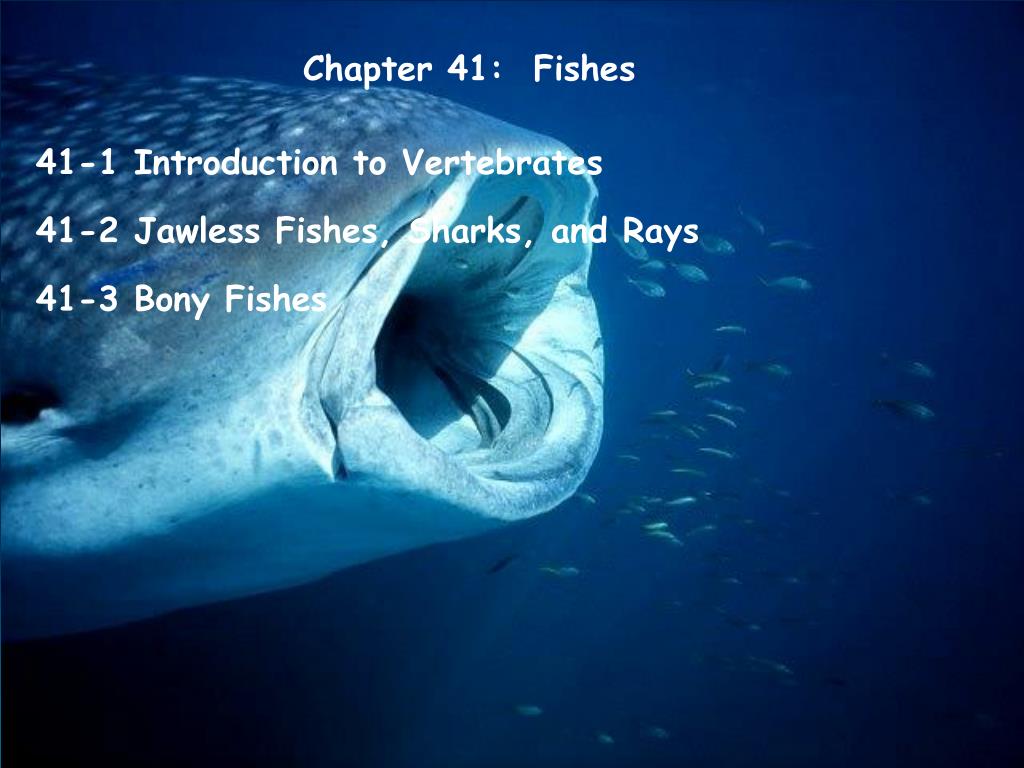
  1. Chapter 41: Fishes 41-1 Introduction to Vertebrates 41-2 Jawless Fishes, Sharks, and Rays 41-3 Bony Fishes

  2. 41-1 Introduction to Vertebrates I. Characteristics of Vertebrates (evolved ~ 550 m.y.a.) • Possess VERTEBRAE (protect DORSAL nerve cord), a CRANIUM (skull), and ENDOSKELETON (bone or cartilage)

  3. (1) Vertebrate Column • Spinal column or BACKBONE that protects spinal cord.

  4. (2) Cranium • Skull encases and protects the BRAIN.

  5. (A) Classification (~ 45,000 species vertebrates, MOST are fishes) • SEVEN classes occupying TERRESTRIAL and AQUATIC habitats.

  6. (1) Lampreys and Hagfishes (~ 80 species) • Elongated, eel-like cartilaginous bodies LACKING jaws, paired fins, and bone.

  7. (2) Sharks, Rays, and Skates (~ 800 species) • Predatory fishes have JAWS, PAIRED FINS, skeletons of CARTILAGE, and a unique type of SCALE (integument).

  8. (3) Bony Fishes (~ 23,000 species) • Jaws, BONY skeleton; TWO bony fish lineages—(1) RAY-Finned Fishes (most species), (2) LOBE-Finned Fishes.

  9. (4) Amphibians (~ 4,500 species) • Thin, MOIST skin permeable to GAS exchange; LAY eggs IN WATER and pass through an aquatic LARVAL stage.

  10. (5) Reptiles (~6,000 species) • Dry, SCALY skin with leathery eggs laid ON LAND, protected against desiccation.

  11. (6) Birds (~ 10,000 species) • Adaptations from reptiles allowing FLIGHT include feathers, HOLLOW bones, and unique RESPIRATORY system.

  12. (7) Mammals (~ 4,400 species) • Presence of INSULATING hair or fur and OFFSPRING are nursed with MILK from mammary glands.

  13. II. Evolution (~ Evolution from Acanthodians, Chordates 550 m.y.a.) • EARLIEST appeared shortly after 1st chordates; ~ early JAWLESS fishes had HEAVY, bony scales; (i.e., Class Agnatha)

  14. (A) Origin of Jaws (evolved ~ 440 m.y.a., out-competing jawless ancestors) • Evolved from GILL ARCHES as an adaptation favoring IMPROVED methods of obtaining nutrition (i.e., improved PREDATION)

  15. (1) Gill Arches (1st pair evolved into JAWS) • Skeletal elements SUPPORT pharynx and evolved into first JAWS.

  16. 41-2 Jawless Fish, Sharks, and Rays I. Life in the Water (adaptations) • Streamlined, muscular tail, paired AND unpaired fins, MUCUS coating, air bladder, and vascular GILLS.

  17. Critical Thinking (1)Many species of fishes that live deep in the ocean, where there is little or no light, are luminescent. What might be the advantages and disadvantages of such an adaptation?

  18. (A) Homeostasis (freshwater VS. marine species of fish, osmosis) • KIDNEYS and GILLS filter blood, regulate ION concentrations (Na, K), and RELEASE wastes.