Understanding Similarity in Polygons and Triangles
350 likes | 455 Vues
This guide explores the concept of similarity in geometry, emphasizing that two objects are similar if they share the same shape but differ in size, with corresponding parts being proportional. It covers characteristics of similar polygons, including congruent corresponding angles and proportional side lengths. The discussion also addresses similar triangles through the AA postulate, SAS, and SSS theorems. Practical applications, such as finding scale factors and using ratio relationships, are included, along with exercises to reinforce comprehension of these principles in various geometric contexts.


Understanding Similarity in Polygons and Triangles
E N D
Presentation Transcript
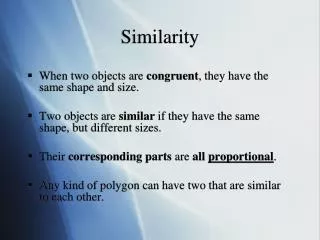
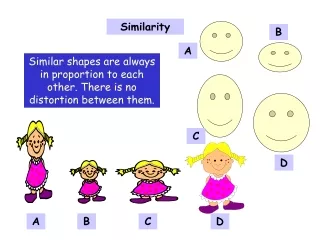
Similarity • When two objects are congruent, they have the same shape and size. • Two objects are similar if they have the same shape, but different sizes. • Their corresponding parts are all proportional. • Any kind of polygon can have two that are similar to each other.
Similarity • Examples: 2 squares that have different lengths of sides. • 2 regular hexagons
Similar Polygons (7-2) Characteristics of similar polygons: • Corresponding angles are congruent (same shape) • Corresponding sides are proportional (lengths of sides have the same ratio) ABCD ~ EFGH Vertices must be listed in order when naming
Similar Polygons (7-2) ABCD ~ EFGH Complete the statements.
Similar Polygons (7-2) • Determine whether the parallelograms are similar. Explain.
Similar Polygons (7-2) • Scale factor- ratio of the lengths of two corresponding sides of two similar polygons • The scale factor can be used to determine unknown lengths of sides
Similar Polygons (7-2) • If ABC ~ YXZ, find the scale factor of the large triangle to the small and find the value of x. scale factor = 5/2 x= 16
Example from Similar Polygons Worksheet • Are the two polygons shown similar? • Corresponding angles must be congruent • All pairs of corresponding sides must be proportional (same scale factor)
Example from Using Similar Polygons Worksheet • Given two similar polygons. Find the missing side length. • Redraw one of the polygons so corresponding sides match up (if needed) • Determine the scale factor • Set up a proportion and solve for the missing side length
Similar Polygons (7-2) • Homework • Similar Polygons worksheet #1-17 odd • Using Similar Polygons worksheet #1-15 odd
Scale Drawing • Problem 2 on p.443 • Complete Similarity Application Problems • More practice p.444 #9, 13, 15, 19, 23, and 25
Similar Triangles (7-3) • AA ~ Postulate – If two angles of one triangle are congruent to two angles of another triangle, then the triangles are similar.
Similar Triangles (7-3) • SAS ~ Theorem – If an angle of one triangle is congruent to an angle of a second triangle, and the sides including the two angles are proportional, then the triangles are similar.
Similar Triangles (7-3) • SSS ~ Theorem – If the corresponding sides of two triangles are proportional, then the triangles are similar.
Similar Triangles (7-3) • Are the triangles similar? If so, write a similarity statement and name the postulate or theorem you used. If not, explain. • No the vertical angle is not between the two pairs of proportional sides.
Similar Triangles (7-3) • Find the value of x.
Indirect Measurement (7-3) • When a 6 ft man casts a shadow 18 ft long, a nearby tree casts a shadow 93 ft long. How tall is the tree?
Homework • 7-4 A Postulate for Similar Triangles (AA) worksheet #1-12 all • 7-5 Theorems For Similar Triangles (SSS and SAS) worksheet #1-6 all • Similar Triangles Worksheet (all three methods)
Similarity in Right Triangles (7-4) • Theorem: The altitude to the hypotenuse of a right triangle divides the triangle into two triangles that are similar to the original triangle and to each other.
Similarity in Right Triangles (7-4) • Geometric mean For any two positive numbers a and b, x is the geometric mean if Another way to find the geometric mean:
Similarity in Right Triangles (7-4) • Find the geometric mean of 32 and 2. • Find the geometric mean of 6 and 20.
Homework • 8-1 worksheet #24-31 all
Proportions in Triangles (7-5) • Side-Splitter Theorem – If a line is parallel to one side of a triangle and intersects the other two sides, then it divides those sides proportionally.
Proportions in Triangles (7-5) • Solve for x. • x = 9
Proportions in Triangles (7-5) • Corollary: If three parallel lines intersect two transversals, then the segments intercepted on the transversals are proportional.
Proportions in Triangles (7-5) • Solve for x. • x = 24
Proportions in Triangles (7-5) • Triangle-Angle-Bisector Theorem – If a ray bisects an angle of a triangle, then it divides the opposite side into two segments that are proportional to the other two sides of the triangle. • x = 18
Proportions in Triangles (7-5) • Solve for x. • x = 11.25
Homework • 7-6 Proportional Lengths worksheet • Proportional Parts in Triangles and Parallel Lines worksheet • p.475 #9-12, 15-22 • Study for test