Introduction to J# and .NET: Summer 2004 Training Overview
This presentation provides an overview of J# within the Microsoft .NET framework, focusing on its features, applications, and advantages. Attendees will explore various application types including console, GUI, and database-driven applications while engaging with a mature GUI example. The training highlights the robustness of .NET, its comparison with J2EE, and the flexibility of choosing programming languages and application domains. Key topics include data structures, algorithms, object-oriented design, and database programming with .NET technologies.

Introduction to J# and .NET: Summer 2004 Training Overview
E N D
Presentation Transcript
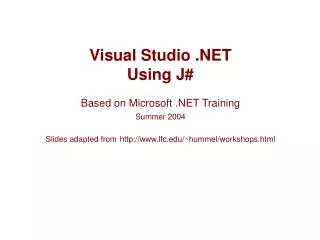
Visual Studio .NETUsing J#Based on Microsoft .NET TrainingSummer 2004Slides adapted fromhttp://www.lfc.edu/~hummel/workshops.html
Goals • Brief Discussion of J#: • the language • data structures, algorithms & OOD • application types: console, GUI, database-driven • Using J# and .NET • Help you: • See a mature GUI in action • Develop a client-server web based application
Why use .NET? • Robust, mature technology & tools • Visual Studio .NET is an excellent development environment • Compares favorably to J2EE, WebSphere(http://msdn.microsoft.com/vstudio/java/compare/) • A study by Forrester Research (see above link) indicates .NET is favored (56%) over J2EE • You have a choice of programming language: • J# is Java 1.4, however with a subset of the Java class libraries. • Microsoft has implemented its own rich set of classes for use across languages (C#, C++, VB) • You have a choice of application domains: • console, graphical user interface (GUI), web, database-driven, …
Outline of the .NET material • Using .NET: • modern program execution through virtual machines • the programming language J# • important algorithms, data structures, and classes • WinForms: Graphical User Interfaces in .NET • WebForms: Like WinForms, but for use on the Web • object-oriented design (OOD) • debugging & testing (with NUnit) • relational databases, SQL, and .NET database programming • web services • the application of J# and .NET to other application domains