Download
1 / 19
190 likes | 328 Vues
This seminar presentation covers the analysis of mixing time for lazy Markov chains within the framework of random walks on graphs. It outlines crucial proofs and methodologies, including bounding distances to stationary distributions and inductive arguments to derive mixing time bounds. The discussion includes the properties of piece-wise linear functions, breaks, and the roles of various graph vertices. Through structured proofs and intuition, the presentation elucidates the relationship between transition probabilities and convergence to equilibrium.

E N D
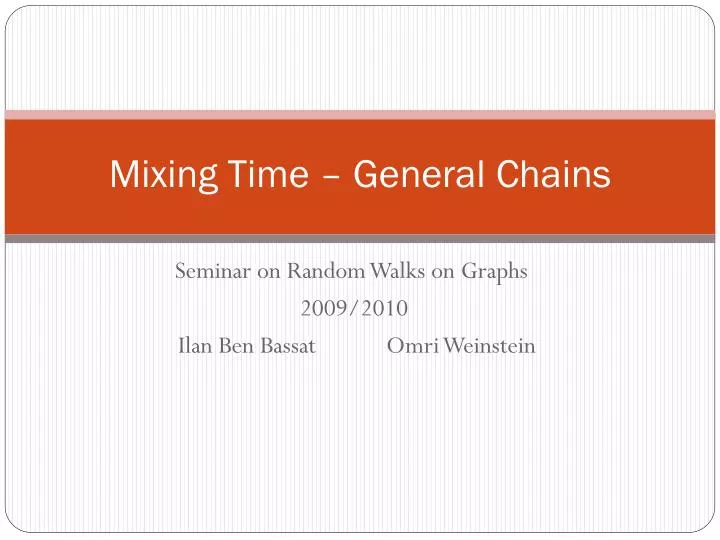
Mixing Time – General Chains Seminar on Random Walks on Graphs 2009/2010 Ilan Ben Bassat Omri Weinstein
Mixing Time - Lazy Chains Given that: Then:
Proof Sketch • Bound distance to stationary distribution by some function h: • Bound the value of ht(x) inductively. • Derive a bound on the mixing time.
Proof Sketch • Bound distance to stationary distribution by some function h: • Bound the value of ht(x) inductively. • Derive a bound on the mixing time.
Bounding Distributions Distance For every
So, choosing for every S yields: And for every vertex w we can get:
H(x) Values Order the graph vertices: And define . Find k such that: Then the value of ht(x) is obtained by: And we get:
Function H - Analysis • Piece-wise linear function. • Concave • Breakpoints at • On the interval [0,1]: and
Proof Sketch • Bound distance to stationary distribution by some function h: • Bound the value of ht(x) inductively. • Derive a bound on the mixing time.
Proof Sketch and Intuition We will prove for every x and t: Intuition: Bound the value h(x) in time t by going one step backwards, and a bit towards the endpoints. Prove will be in three parts: • For a finite group of discrete x values . • For all x values satisfying (and symmetric case). • For all x values and
Proof – Breakpoints Fix k and let
Proof – Third Part So, for every x we get:
Induction For t=0 trivial. For and
Proof Sketch • Bound distance to stationary distribution by some function h: • Bound the value of ht(x) inductively. • Derive a bound on the mixing time.
Mixing Time Proof Given