Join the Philadelphia Area SharePoint User Group for Insights and Networking
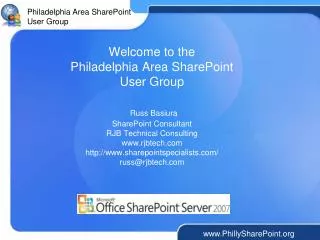
Welcome to the Philadelphia Area SharePoint User Group! Our goal is to build a vibrant local community focused on Microsoft SharePoint technologies. Join us for our next meeting on March 26th from 5:30 PM to 8:30 PM at the Microsoft Greater PA Office in Malvern, PA. This session will cover the implementation and support of Information Architecture and various SharePoint solutions. Engage in enlightening discussions, share best practices, and enhance your SharePoint knowledge. Check our website for resources and updates on upcoming events!

Join the Philadelphia Area SharePoint User Group for Insights and Networking
E N D
Presentation Transcript
Welcome to the Philadelphia Area SharePoint User GroupRuss BasiuraSharePoint ConsultantRJB Technical Consultingwww.rjbtech.comhttp://www.sharepointspecialists.com/russ@rjbtech.com
AGENDA • Quick Intro • Announcements • PhillySharePoint Website • Defining your Enterprise Information Architecture • Round Table Q & A
User Group Goal / Objectives • Build a local community focused on Microsoft SharePoint Technologies • Educate user group members about SharePoint Technologies • Transfer knowledge within the community • Communicate best practices • Introduce new products / solutions
www.PhillySharePoint.org Website for user group • SharePoint resource documents • SharePoint resource websites links • RSS Feeds • Meeting Event Schedule • Past User Group Presentations • Live Meetings • Public Discussions • Member Forums • Member Blogs
Upcoming Schedule • Next Meeting • March 26th 5:30 PM to 8:30 PM • RJB Technical Consulting • IA Part 2 – Implementation and Support • MOSS on W2k8 and SQL2k8 64-bit • Microsoft Greater PA Office, Malvern, PA • Ongoing Schedule • Last Wednesday of every month • 5:30 PM to 8:30 PM • Microsoft Greater PA Office, Malvern, PA
Conferences • MS SharePoint Conference 2008 • Seattle, WA • March 3 – 6 • http://www.mssharepointconference.com
Introductions PhillySharePoint Sponsors • Microsoft • Leader in software solutions • AvePoint • Leader in SharePoint Disaster Recovery Solutions • RJB Technical Consulting (www.rjbtech.com) • Philadelphia-based consulting company • Microsoft Partner • Practice Area focused on SharePoint and Information Worker Technologies • Office 2007, SharePoint 2007 Private Beta Partner
Calling all SharePoint architects, developers, engineers, project managers, business analysts, customizers and power users!! • RJBTech is adding new team members. We offer the opportunity to work on some of the most exciting SharePoint deployment projects in the Philadelphia area. We offer: • Bonuses • Paid SharePoint training • medical, dental, and vision • paid vacation • Paid holidays
Defining the Enterprise Information ArchitectureRuss BasiuraRJB Technical Consulting
What is Information Architecture? Information architecture (IA) is the art and science of expressing a model or concept for information. --WikiPedia.org Information architecture is : • The structural design of shared information environments. • The art and science of organizing and labeling web sites, intranets, online communities and software to support findability and usability. • An emerging community of practice focused on bringing principles of design and architecture to the digital landscape. -- Information Architecture Institute
Information Architecture • Define goals • Know your audience • Define information types • Define site structure
How do users find information? • Ask them? • Use card sorting techniques • Focus on keywords • Examine file shares to gather Information types and metadata • Use the feed back to build • Site Directory • Wireframes and Storyboards
Who owns the IA? • IA is living and breathing – constant change • Everyone is the steward of change • Changes are centrally administered and deployed through features • Site collection administrators (content owners)
SharePoint IA • How is your Information Architecture represented in SharePoint? • Web Applications • Site Collections • Sites • Lists and Libraries • Content Types • Metadata - Keywords
When do you need a Web Application? • IIS Virtual Server • Isolation – Application Pools • Authentication – Windows, Basic, Forms • Host Header Definition • Unique Web.config file – data connections • Different feature deployment • Can contain many site collections and content databases
Site Collection Properties • Quota • Recycle Bin • Site and List Templates • Content Types • Site Columns • Security Groups and Users • Usage Reports • Navigation • Portability
When do you need a Site Collection? • Driven by • content size • Content owners / administrators • security
When do you need a Site? • Different site template • Different audience for your content • Different Security • Different site administrator • What content will be put into it? • Different branding (master page, page layouts, stylesheets) • Different functionality
When do you need a list or library? • Minor versioning • Receive email • Document conversions (library) • Custom send to (library) • Content types – lists only types
How do you decide the type of site? • Enterprise • Aggregation of content • Personalization of content • Cross-site searching • Web publishing • large audience • Mostly read-only • Team • Small audience
Content Types • Create your own base content types • Keep structure flat initially • Define site columns and metadata • Information Management Policies
Navigation • Consistency throughout site (navigational elements) • SharePoint knowledge required in order to understand relationship between the various objects (site collections, webs, lists, etc…) • Alignment with information architecture – search scoping • Branding considerations – using themes and custom master pages to help identify location within a portal • Provide an overall picture – site map – to communicate the big picture to users
Questions to New Site Owners • Who is your audience? • Will the content be shared externally? • What information will be stored? • Have you been to SharePoint training? • What is avg. document size? • How many documents? • Which department? • Who is the site owner? • How many contributors? • How many readers? • What is scope of search (global or local)?
Resources • Information Architecture Institutehttp://iainstitute.org/ • Microsoft Technethttp://office.microsoft.com/en-us/sharepointserver/HA102147321033.aspx • Joel Oleson – SharePoint Bloghttp://blogs.msdn.com/joelo/archive/2007/03/16/information-architecture-and-the-information-architect.aspx