Environmental Impact of Emissions from International Sea Transportation
This study investigates emissions from international sea transportation, focusing on the environmental impact of volatile organic compounds (VOCs) from crude oil carriers. An analysis of emission trends from 1960 to 2000 was prepared for the RETRO project using simplified trends derived from fuel sales statistics. The study explores existing traffic, fuel consumption trends, and future perspectives, particularly in light of the forthcoming IMO Annex VI regulations. The research utilizes advanced CTM models running at higher resolutions and integrates new data on sulfur, oxidation chemistry, and carbonaceous aerosols.

Environmental Impact of Emissions from International Sea Transportation
E N D
Presentation Transcript
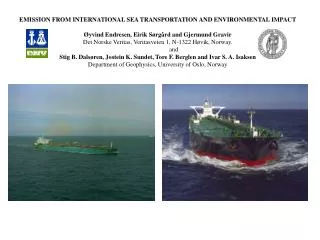
EMISSION FROM INTERNATIONAL SEA TRANSPORTATION AND ENVIRONMENTAL IMPACTØyvind Endresen, Eirik Sørgård and Gjermund GravirDet Norske Veritas, Veritasveien 1, N-1322 Høvik, Norway. andStig B. Dalsøren, Jostein K. Sundet, Tore F. Berglen and Ivar S. A. IsaksenDepartment of Geophysics, University of Oslo, Norway
Included i next update of Edgar database • 1960 to 2000 emissions prepared for RETRO project. Simplified trend derived from from fuel sales statistics.
New study • Future perspective (2015) • Existing traffic, trends fuel consumption and coming IMO annex VI regulations • New activity/traffic • Improved CTM, running with higher resolution (T63), coupled sulphur and oxidation chemistry, including carbonaceous aerosols