ASTRO-WISE: An Astronomical Wide-field Imaging System for Europe
ASTRO-WISE is a system designed to handle vast amounts of data from wide-field astronomical imaging instruments. It provides a flexible solution for data reduction, calibration, source extraction, and visualization. The system allows for the dynamic growth of an archive that can be used for various scientific projects and collaborations.

ASTRO-WISE: An Astronomical Wide-field Imaging System for Europe
E N D
Presentation Transcript
ASTRO-WISE An Astronomical Wide-field Imaging System for Europe Konrad Kuijken, Edwin Valentijn Kapteyn Institute, Groningen Towards an International VO - Garching bei Munchen
VST + OmegaCAM 6x WFI 1o x 1o 16k x 16k pixels Towards an International VO - Garching bei Munchen
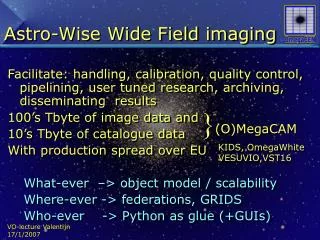
The Problem • Many wide-field imaging instruments, vast amounts of data • E.g.: VST = Southern sky (30 min exp, 300 nights/y) in 3 years. Vast amount of data! 100 Tbyte • Science on these data should be archive-based • Handling of the data is non-trivial • Reduction • Calibration and re-calibration • Image comparisons and combinations • Working with source lists • Visualization • ASTRO-WISE aim: • provide a system for maximal data handling flexibility Towards an International VO - Garching bei Munchen
Concept solution • Environment which • Has access to all raw and calibration data • Can run and modify reduction/calibration pipelines • Can run source extraction algorithms • Archives reduced data and source lists, or regenerates these dynamically • Can be federated to link different data centers • This dynamical archive continuously grows as more raw data enter the system, and can be used for • `small’ or large science projects • generating and checking calibration data • exchanging methods and scripts • A key functionality is the link back from source data to the original raw pixel data and calibration files Towards an International VO - Garching bei Munchen
Example uses • Deep multi-colour fields • No need to take all data in one campaign • Combine data of particular quality, assess results • Select sources, visualize interesting ones, … • 1-in-1,000,000 events spurious or not? • Large homogeneous surveys • Eg weak lensing maps, cluster searches, star counts • Variability (source list- or pixel based) • Proper motions (asteroids, nearby stars) • Flux variations Towards an International VO - Garching bei Munchen
Example uses • Monitor instrument (calibration files) • Planning observations • View quality of existing data • Build on what already exists, add more filters, more exposure time, better seeing, … • All this can be done on the continuously growing archive Towards an International VO - Garching bei Munchen
Philosophy • System is not geared to a single data product, but to being a flexible tool. • Not focused on making a single, homogeneous survey with static data release(s) - but could be used for this • Optimise interaction between users and their data Dynamic archive • Geared to optical (IR) wide-field image data Towards an International VO - Garching bei Munchen
Partners • Distribute the load/environment over National centers, each serving their community • Partners: • NL - Groningen (+ Leiden) • ESO – EIS • I – Napoli + • F - Terapix • D – USM + • UK - VISTA Edinburgh/Cambridge • 1.5 MEuro grant from EU RTD programme Towards an International VO - Garching bei Munchen
How? • Procedurizing data taking at telescope for both science and calibration data • Full integration with data reduction OmegaCAM FDR • Data model (classes) defined for data reduction and calibration • Design • View pipeline as an administrative problem Towards an International VO - Garching bei Munchen
Tbyte source lists- brains make the associations Link -lists Towards an International VO - Garching bei Munchen as fast as possible
Share the load • Hardware: Beowulf processors – 32 (most cases) • Hardware: multi Terabyte disks (10 – 100) • Data reduction: derive calibration • Data reduction: run image pipeline (1 Mpx/s) • Archive: storage of images (100’s Tbyte) • Archive: storage of source parameters (1-10 Tbyte) Network speed free parameter: - from 5 Mb/s (24 hours/day provides full replication of all OmegaCAM data) - to 200 Mb/s no replication Towards an International VO - Garching bei Munchen
Federate • Calibration results • Methods (pipelines) for processing calibration • Raw data • Reduced images • Source lists - catalogues Towards an International VO - Garching bei Munchen
Concepts • Federation maintained by asingle db • Full history tracking of all input that went into result providing on-the fly reprocessing – tell me everything tools • Dynamical archive - Context areas in object attributes • Project: eg Cal, Science, Survey, Personal • Owner: eg pipeline, developer, user • Strategy: Standard, Deep, Freq (monitoring) • Mode: Stare, Jitter, Dither • Time: time stamping • Standards • classes/data model/ procedures • 00 – inheritance/ persistency • Python scripts/ libraries Partitions Link to AVO VO table Towards an International VO - Garching bei Munchen
DB – engine Oracle contract: – reference – licenses - consultancy Oracle 9i: • federation through “Advanced replication” to evolve into cross site links (=references= pointers) • Python I/F SQL – OCI- Oracle db • Full oo support + Python to db persistency • Terabyte scalability through “partitioned tables” • Administration tools • Interoperability: STREAMS connects to others: SyBase, MySQL Towards an International VO - Garching bei Munchen
Intra-operability peer to peer • CVS • “Advanced Replication” evolving to pointers Towards an International VO - Garching bei Munchen
WP s • WP 1 – pipelines / same as ESO-DMD • Implement and operate • WP 2 – visualization tools • Panorapix – fast Gbyte image display + true colour • Graphic cards – OpenGL - • WP3 – federated db’s • CVS • Oracle • WP4 – processing power 4 Beowulf centers • WP5 – direct access 100 Tbyte storage • WP6 – coordinate – AVO – CERN-HEP- Datagrid ASTRO-GRID Towards an International VO - Garching bei Munchen
Schedule • ADD – review Q2 2002- OK • Basic operations – Q4 2003 • Evaluate and prepare for mass production 2004 • Qualify and populate 2005 • Deliver survey system – satellites • Links to LOFAR, JIVE,WHIRCAM, GAIA Personal Observatory Towards an International VO - Garching bei Munchen