SlideServe
Menu
Préférences
© SlideServe · v2026

Learning to Hide in the Digital Age

amelia avatar
13 diapositives · 291 Views · Aug 01, 2014

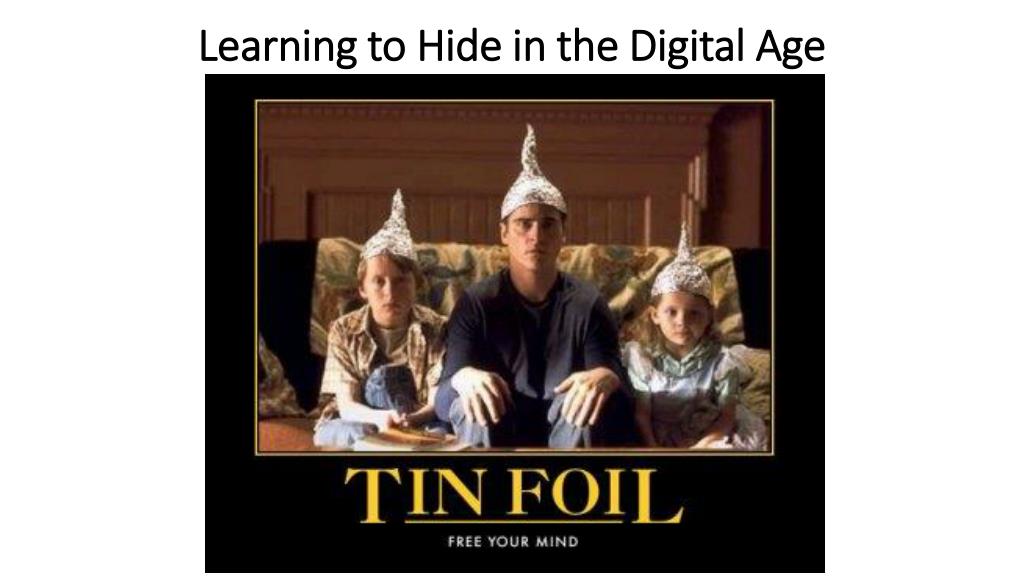
Learning to Hide in the Digital Age. Can you completely remove your online identity?. Online Privacy is Dead. Identity Theft Videos. See how easily freaks can take over your life Amazing mind reader reveals his 'gift '. We want our online privacy.
Learning to Hide in the Digital Age - slide 1
01 / 13Learning to Hide in the Digital Age
1 / 17

Télécharger la présentation

Learning to Hide in the Digital Age
Une image / un lien ci-dessous est fourni (tel quel) pour télécharger la présentation

Politique de téléchargement : le contenu du site vous est fourni TEL QUEL pour votre information et votre usage personnel ; il ne peut être vendu, concédé sous licence ni partagé sur d’autres sites sans l’accord de son auteur.Le contenu vous est fourni TEL QUEL, pour votre information et votre usage personnel uniquement. Téléchargez la présentation en cliquant sur ce lien. Lors du téléchargement, si vous ne parvenez pas à télécharger une présentation, l’éditeur a peut-être supprimé le fichier de son serveur.Pendant le téléchargement, si vous ne parvenez pas à obtenir une présentation, le fichier a peut-être été supprimé par l’éditeur.

F I N

Plus de contenu associé

Transcription de la présentation
  1. Learning to Hide in the Digital Age

  2. Can you completely remove your online identity?

  3. Online Privacy is Dead

  4. Identity Theft Videos • See how easily freaks can take over your life • Amazing mind reader reveals his 'gift'

  5. We want our online privacy • 86% of Internet users have taken steps online to remove or mask their digital footprints • 55% of Internet users have taken steps to avoid observation by specific people, organizations, or the government • 59% of Internet users do not believe it is possible to be completely anonymous online, while 37% of them believe it is possible. • 68% of internet users believe current laws are not good enough in protecting people’s privacy online • 24% believe current laws provide reasonable protections.

  6. Who is tracking us online?

  7. Why are you being tracked online? • Providing you a better user experience. • Inexpensive and plentiful storage and power(Big Data) • National and Security Intelligence • Identity theft: • Identity cloning and concealment • Criminal identity theft • Synthetic identity theft • Medical identity theft • Child identity theft

  8. Where are you being tracked • Facebook and Social Networks • GPS (Smartphones and tablets) • Email • Search Engines • Cookies • Automatic License Plate Readers • Surveillance Cameras and Closed-Circuit Television

  9. When are you being tracked online? • When you turn on your computer/smartphone/tablet and until you turn it off.

  10. What is being tracked • Every click, tap, and swipe you make on the Internet is being tracked, not just by your browser but by many of the companies that connect that click, tap, and swipeto your IP address -- then to your name. And that data is sold to the highest bidder.

  11. How your data is used • Relevant Search Results - Good! • Recommendations - Good! • Info based on user action - Good! • Excessive Ad Retargeting - Bad! • Identity Theft – Ugly! • Selling data – Ugly!

  12. The Delicate Balance Between Convenience and Security • Libguide

  13. Thank You!! Questions?! • Wanda Huffaker – whuffaker@slcolibrary.org • Steve Irving - stevenirving@suu.edu • Phil Roche’ - roche@suu.edu • ULA Intellectual Freedom Committee Website • ULA-IFC on Facebook