Understanding Potential Energy: Calculation and Examples
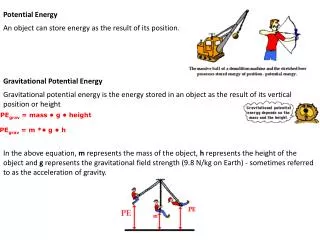
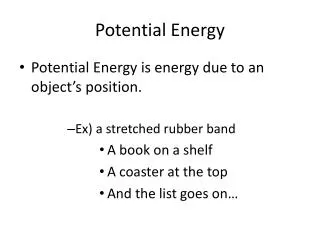
Potential energy is the energy stored in an object due to its position. Common examples include a stretched rubber band, a book on a shelf, and a coaster at the top of a hill. The potential energy (PE) can be calculated using the formula PE = mgh, where m is mass in kilograms, g is the acceleration due to gravity (9.8 m/s²), and h is height in meters. For instance, a 50 kg skateboarder at the top of a 5 m half-pipe has a potential energy of 2,500 Joules. This concept is essential for understanding energy transformations.

Understanding Potential Energy: Calculation and Examples
E N D
Presentation Transcript
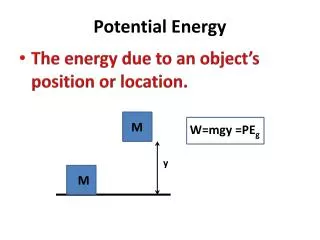
Potential Energy • Potential Energy is energy due to an object’s position. • Ex) a stretched rubber band • A book on a shelf • A coaster at the top • And the list goes on…
Calculate it! • Potential Energy = mgh • m = mass in kilograms • g = gravity (9.8m/s2) • h = height in meters
Practice • A skateboarder who weighs 50kg is perched at the top of a half pipe. The half pipe is 5m tall. What is the skateboarders potential energy? PE = 50kg*10m/s2*5m PE = 2,500 Joules
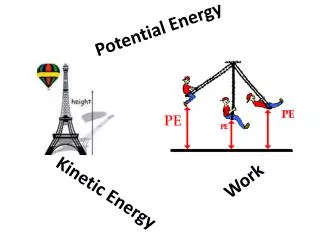
Energy Graphing PE KE TE