Mutations
Mutations are changes in the nucleotide sequence of DNA, which can occur in somatic or gametic cells. While most mutations are neutral, some can be beneficial or lead to disorders. Types of mutations include chromosome mutations like deletion, inversion, translocation, insertion, and duplication. Mutations can arise from external factors like chemicals and UV radiation but can also be repaired by enzymes. Conditions like Down syndrome and various other genetic disorders stem from specific chromosomal mutations. Understanding these changes helps in the study of genetics and evolution.

Mutations
E N D
Presentation Transcript
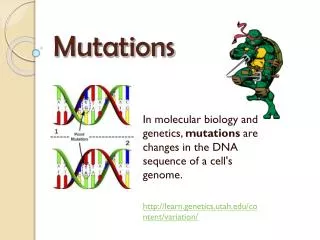
What Are Mutations? • Changes in the nucleotide sequence of DNA (big or small) • May occur in somatic cells (aren’t passed to offspring) • May occur in gametes (eggs & sperm) and be passed to offspring
Are Mutations Helpful or Harmful? • Mutations happen regularly • Almost all mutations are neutral • Chemicals & UV radiation cause mutations • Many mutations are repaired by enzymes
Are Mutations Helpful or Harmful? • Some type of skin cancers and leukemia result from somatic mutations • Some mutations may improve an organism’s survival (beneficial)
Chromosome Mutations • May Involve: • Changing the structure of a chromosome • The loss or gain of part of a chromosome
Chromosome Mutations • Six types exist: • Deletion • Inversion • Translocation • Insertion • Duplication • Aneuploidy by nondisjunction
Deletion • Due to breakage • A piece of a chromosome is lost
Disorders due to chromosome deletions: • Cri du Chat – deletion of short arm of 5 • 1p36 Deletion Syndrome-deletion of short arm of 1 • Angleman Syndrome- deletion of short arm of maternal 15 • Prader-Willi syndrome- deletion of short arm of paternal 15
Inversion • Chromosome segment breaks off • Segment flips around backwards • Segment reattaches
Disorders caused by inversions: • If they are “balanced” they cause no phenotype • If they are “unbalanced” they usually are associated with a deletion and several effects
Duplication • Occurs when a gene sequence is repeated
Translocation • Involves two chromosomes that aren’t homologous • Part of one chromosome is transferred to another chromosome and swapped with a region of that chromosome
Disorders caused by translocations • “Robertsonian” usually show no phenotypes but often problems during meiosis leading to miscarriages in developing fetus. • Common to have Robertsonian traslocation of 13 and 14. • If translocation of long arm of 21 and long arm of 14-Down’s • Some cancer cells have translocations (leukemia, sarcoma)
Insertion • A piece of one • Chromosome gets • Inserted into • Another • Chromosome • Effect depends • on what was • Inserted and wheree
Nondisjunction • Failure of chromosomes to separate during meiosis • Causes gamete to have too many or too few chromosomes • Disorders: • DownSyndrome – three 21st chromosomes • Turner Syndrome – single X chromosome • Klinefelter’s Syndrome – XXY chromosomes
Some Aneuploid Chromosomal Disorders • Patau Syndrome • Edward Syndrome • Klinfelter’s Syndrome • Turner Syndrome • Super Male Syndrome • Super Female Syndrome • Down’s Syndrome
Normal Male 2n = 46
Normal Female 2n = 46
47, XY, +13 • serious eye, brain, circulatory defects as well as cleft palate. 1:5000 live births. Children rarely live more than a few months. • Patau Syndrome
Edward Syndrome • almost every organ system affected 1:10,000 live births. Children with full Trisomy 18 generally do not live more than a few months.
Male, Trisomy 21 (Down’s) 2n = 47
Female Down’s Syndrome 2n = 47
Down’s Syndrome Characteristics • One in 733 births • Slow cognitive ability and growth • Small chin • Round face • Almond shaped, often upslanting eyes • Heart defects • Gastric reflux disease • Thyroid problems
Klinefelter’s Syndrome 2n = 47
Turner’s Syndrome 2n = 45