Download
1 / 8
80 likes | 212 Vues
In March 2010, 59% of 4th-grade students achieved proficient or higher scores in math. This performance analysis focuses on Algebra, Functions, Geometry, Statistics, and Data, while assessing S.M.A.R.T. goals: Specific, Measurable, Attainable, Realistic, and Timely. We also review Quarter 4 standards, such as understanding area and perimeter formulas, congruence, symmetry, angles, and the characteristics of various geometric figures. This document helps reflect on our progress and guides students in setting achievable goals for improvement.

E N D
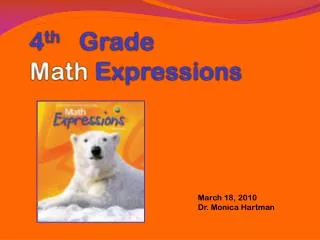
4th Grade Math Data Meeting 3 Quarter March 2010
PERFORMANCE ACROSS THE QUARTERS 59 % Students scored proficient or higher!
S.M.A.R.T GOALS Did we meet our GOALS??? Specific Measureable Attainable Realistic Timely Students should make goals too!
STANDARDS FOR QUARTER 4 MG 1.4 Understand and use formulas to solve problems involving perimeters and areas of rectangles and squares. Use those formulas to find the areas of more complex figures by dividing the figures into basic shapes MG 3.3 Identify congruent figures MG 3.4 Identify figures that have bilateral and rotational symmetry MG 3.5 Know the definitions of a right angle, an acute angle, and an obtuse angle. Understand that 90 ° 180 ° , 270 ° , and 360 ° are associated, respectively, with 1/4, 1/2, 3/4, and full turns. MG 3.1 Identify lines that are parallel and perpendicular. MG 3.2 Identify the radius and diameter of a circle (NOT CIRCUMFERENCE) MG3.6 Visualize, describe, and make models of geometric solids (e.g., prisms, pyramids) in terms of the number and shape of faces, edges, and vertices; interpret two- dimensional representations of three-dimensional objects; and draw patterns (of faces) for a solid that, when cut and folded, will make a model of the solid. MG 3.7 Know the definitions of different triangles (e.g., equilateral, isosceles, scalene) and identify their attributes MG 3.8 Know the definition of different quadrilaterals (e.g., rhombus, square, rectangle, parallelogram, trapezoid). SDAP2.1 Represent all possible outcomes for a simple probability situation in an organized way (e.g., tables, grids, tree diagrams). SDAP 2.2 Express outcomes of experimental probability situations