Download
1 / 11
110 likes | 315 Vues
This comprehensive overview covers essential biochemistry and basic chemistry concepts crucial for understanding medical microbiology. Topics include atomic structure, elements, and the periodic table, along with a detailed examination of molecules and compounds. Key aspects of acids, bases, and pH, as well as the distinction between inorganic and organic compounds, are discussed. The document also delves into carbohydrates, lipids, proteins, and nucleic acids, including their structures and functions. This foundational knowledge is vital for students and professionals in the field of medical microbiology.

E N D
Unit 2Biochemistry Medical Microbiology Ms. Harborth Ms. Grover
Basic Chemistry • Atoms • Nucleus (protons, neutrons) • electrons • Elements • Periodic Table – order of reactivity • 20 elements in living matter • 4 make up 97% of living tissue, rest are called trace
Basic Chemistry • Molecules • 2 or more atoms bonded together • Compounds • 2 or more atoms joined together in proportion by weight • Reactants vs products • Inorganic vs organic compounds • Solutions • Solute • Solvent • Soluble vs insoluble • Water = universal solvent. POLAR
Acids, Bases, and Salts • Acid • Substance that ionizes in water into H3O+ ions • Base • Substance that ionizes in water into OH- ions • Neutralization and salts • Acid + Base -> Salt + Water
pH • pH = measure of acidity • Indicators: special chemicals used to test for H+ ions. Example: Blue litmus paper (A-red, B-blue), bromothymol blue (A-yellow, B-blue), Phenolphthalein (A-colorless, B- pink) • 7 = neutral pH • 0-6.9 = acid • 7.1-14 = base • Tears: 7.3, blood: 7.4, urine: 5-7.5 • Buffers: biological compounds that keep the pH at homeostasis
Inorganic vs Organic Compounds • Inorganic: • Don’t have carbon (except CO2, CaCO3) • Smaller and simpler compounds • Organic: • Have carbon, hydrogen, and oxygen. • Usually contain nitrogen and phosphorus • Large an complex compounds • Hydrocarbons – consisting of only carbon and hydrogen
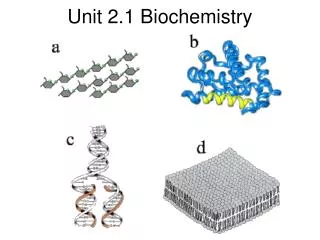
Carbohydrates • Contain C, H, and O in ratio of 1:2:1 • Monosaccharides • Simple sugar • Glucose – C6H12O6 • Fructose • Galactose • Disaccharides • Two sugars bonded together • Sucrose = glucose + fructose • Lactose = glucose + galactose • Polysaccharides • Huge! • Starch, cellulose, glycogen, chitin
Lipids • Fats, oils, waxes • More energy storage than carbs • 1 glycerol + 3 fatty acids • 3 kinds: • Simple: C, H, and O • Fats and oils (butter, beeswax, olive oil, peanut oil, etc) • Saturated (solid at room temp, all C bonds are saturated with H, BAD fat) • Unsaturated (liquid at room temp, C double bonds to C, GOOD fat) • Compound: C, H, O, N, and P • Amount remains constant in organism • Phospholipids and glycolipids (neurons) • Derived – C, H, and O • Steroids, vitamin D, cholesterol, vitamins A, D, E, and K
Proteins • C, H, O, N, and S • Made of amino acids bonded in peptide bonds • Amino Acids: • 20 total • Basic structure with an “R” group • Protein Structure: • Primary – straight chain • Secondary – fibrous proteins; alpha helix, beta pleated sheets. Ex: hair, nails • Tertiary – globular protein. Ex: enzymes • Quaternary – 2 or more globular proteins bonded together. Ex: hemoglobin
Enzymes • Proteins! • Organic catalysts • Highly specific • Active site/ substrate
Nucleic Acids • C, H, O, N, and P • DNA, RNA, ATP • Made of nucleotides • Sugar, phosphate, and nitrogenous base • DNA • Double stranded, deoxyribose, ATCG • RNA • Single stranded, ribose, AUCG