Evidence of Evolution: Fossil Records, Biological Molecules, Anatomy, and Development
Explore the evidence of evolution through fossil records, biological molecules, anatomy, and development. Understand how these sources provide insights into the history and patterns of life on Earth.

Evidence of Evolution: Fossil Records, Biological Molecules, Anatomy, and Development
E N D
Presentation Transcript
Chapter 16 Section 4 Evidence of Evolution
DO NOW • Read the following passage on Earth’s history of life and explain: • “Of this history, we possess the last volume alone…Of this volume , only here and there a short chapter has been preserved; and of each page, only here and there a few lines.”
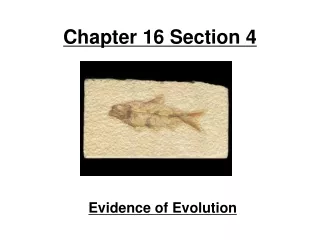
Fossils Provide a Record of Evolution • ________ are preserved or mineralized remains of an organism • They provide a record of past ________________ • ________ fossilized species are different from newer ones • They show _______ between great groups of organisms
Scientists agree on three major points • Earth is about __________ years old • Organisms have inhabited the Earth for most of its history • All organisms living today ________ from earlier, simpler life forms
Fossil records are not complete • Many species live in environments where fossils do not form • Most form where organisms are ____________buried in fine sediments deposited by water, wind, or volcanoes • Organisms living in ___________,___________, _______________ will probably NOT form fossils • Paleontologists study fossils and can predict their age using radiometric dating
Biological Molecules contain a record of evolution • Proteins- Species that evolved from an ancestor in the distant past should have ________ amino acid differences than those who shared a common ancestor more recently (Example: hemoglobin differences to humans: gorilla=1, monkey=8, mouse=27, chicken=45, frog=67) • Nucleic acids- comparing nucleotide sequences also shows how long it has been since two species _______________ • Together proteins and nucleic acids support the fossil record
Anatomy suggests common ancestry • __________ ___________ present in an organism but are reduced in size and either have no use or have a less important function than in other related organisms Examples: _______________ __________________________
Homologous structures- structures that share __________ ____________ Example: forelimbs of vertebrates are made form the same basic groups of bones
Development also suggests common ancestry • Embryo development is __________ in organisms with common ancestry
How quickly does evolution occur? • _______________- gradual change over long periods of time leads to species formation • Punctuated equilibrium-periods of __________change in species are separated by periods of little or no change ( caused by major environmental changes)