Counter-Terrorism and WMD: 1999 Implementation Highlights and Future Coordination Efforts
This session discusses counter-terrorism (CT) issues, exercise results, and funding initiatives as highlighted in 1999. Presentations by key figures like Ken Stroech (EPA) and experts from FEMA, USCG, and CDC shed light on training, guidance development, and technical advances in the realm of weapons of mass destruction (WMD). Additionally, it covers interagency coordination efforts involving various federal and state agencies, revealing progress and facing challenges in emergency response and preparedness strategies for countering terrorism and managing WMD threats.

Counter-Terrorism and WMD: 1999 Implementation Highlights and Future Coordination Efforts
E N D
Presentation Transcript
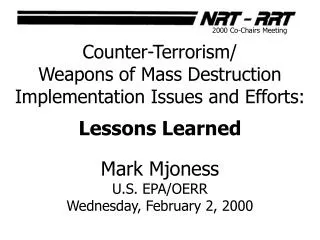
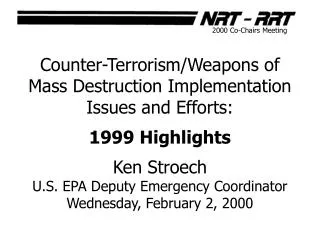
Counter-Terrorism/Weapons of Mass Destruction Implementation Issues and Efforts:1999 HighlightsKen StroechU.S. EPA Deputy Emergency CoordinatorWednesday, February 2, 2000
Session Purpose • To discuss CT issues, exercise results, & recent funding initiatives • To learn about NRT agencies’ CT activities • To further define the role of and future path for NRT and RRTs in coordination, response, and technical support
Session Format • Presentations • Ken Stroech - 1999 CT Highlights (10 mins.) • Tom Smith - FEMA Consequence Management (10 mins.) • Alan Peek - USCG CT Update (10 mins.) • Mark Mjoness - Lessons Learned (15 mins.) • Dennis Carney, Terry Brubaker, Chris Field • Scott Lillibridge - CDC/ATSDR Update (20 mins.) • Roundtable discussion • “The Way Ahead . . . NRT/RRT Options for CT Focus” - John Gustafson (20 mins.)
1999 CT Highlights • Training Involvement • Level-A training/exercise for regions • Emphasized terrorism-specific response and equipment • Participation in the Domestic Preparedness Program • Emergency Coordination Workshop • Region III CEPP Conference • WMD Coordinators Training
1999 CT Highlights • Guidance Development • Regional CT Reference Manual • Bio Decon Plan • CT Electronic Resource Center • Technical Advances • EPA’s CT Technical Workgroup formed • Mobile Evidence Collection Lab
1999 CT Highlights • Interagency interaction • Coordination with Department and Agency CT program leaders • National Security Council (NSC) • DOD Workgroups • National Guard • Joint Task Force - Civil Support (JTF-CS) • DOJ’s National Domestic Preparedness Office (NDPO) • National Joint Information Center Model approved
Changes: DOJ Grants • FY99 County and Municipal Agency Domestic Preparedness Equipment Support Program • Provides $69.5 M for equipment purchases • Eligible to largest 157 metropolitan jurisdictions • FY99 State Domestic Preparedness Equipment Support Program • Targeting 50 States • Developing planning tools to assess need, risk, and threat • Municipal Fire and Emergency Services Program • Provides $25 M to expand equipment and training programs
Changes: DOJ’s NDPO • NDPO officially authorized • Draft "Blueprint" expected to clear soon • The State and Local Advisory Committee in final stages of approval • Information sharing/ outreach
NDPO • Increased interagency coordination • Standardized Equipment List (SEL) • Training Compendium • Interagency Equipment Standards • National Strategy • JOC/ICS Operational Interface • Information Sharing/Outreach • Beacon newsletter
Changes: DOD • DOD Joint Task Force - Civil Support • Ensures DoD assets are prepared to respond in a national crisis • Supports the LFA to orchestrate the deployment of DoD assets • WMD Civil Support Teams • Formerly RAID teams • Creation of 17 new teams announced = 27 Teams
FY00 Budget Recommendations • 19 FTE currently utilized in Regions • Will focus on top 2 of 5 priorities • Training (health & safety emphasis) - 11 FTE • Regional CT Coordinator positions - 8 FTE • Need additional 19 FTE to expand work on remaining three priorities • Special Events - 5 FTE • External Preparedness - 11 FTE • Equipment and Maintenance - 3 FTE • FY00 regional implementation plans
EPA Budget Needs • NSC/WMDP CT Budget Initiative • EPA submitted a 3-tiered CT initiative • Tier I - 57 FTE and $28.3M • Tier II - 89 FTE and $40.9M • Tier III - 137 FTE and $55.1M • NSC was expected to recommend the Tier II option to OMB
EPA Budget Requests • FY2001 Initiative • Reprogramming FTE and dollars • Over-target request for FTE and dollars • Infrastructure responsibilities • Water - dollars for R&D as lead agency for water supply sector • Infrastructure - dollars for critical infrastructure protections (cyber and physical)
Summary • Training has been conducted. . . • Guidance has been developed. . . • Technical advances have been made. . . • Interagency actions have been coordinated. . . • Changes are occurring - progress is being made. . . However, significant challenges remain for all of us in CT involvement