Download
1 / 11
110 likes | 219 Vues
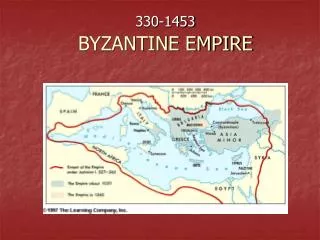
The Byzantine Empire, often referred to as New Rome, emerged from the remnants of the Roman Empire and survived for over a millennium after the fall of Rome in 476 AD. While it shared foundational aspects such as government and legal systems with its predecessor, it evolved unique characteristics: Greek became the dominant language, and its culture was firmly rooted in Orthodox Christianity rather than pagan beliefs. The differences were marked by its emphasis on trade across Asia and Europe, distinct religious traditions, and key historical figures like Emperor Justinian and Empress Theodora, who left a lasting imprint on Byzantine governance and society.

E N D
Relationship of Byzantine Empire to Roman Empire • German • Byzantium Constantinople • New Rome *would carry on the glory of Rome • Religious beliefs The Byzantine Empire shared much with Rome, both its legal system and form of government and the rulers were direct descendants of the Roman rulers.
What made the byzantine empire different from the Roman Empire?
Trade and Religion 5) Location trade 6) Asia and Europe 7) Christianity 8) Greek, Roman, and Christian 9) Hippodrome The Byzantine Empire continued 1000 yrs after the fall of Roman Empire in 476 AD.
What made the byzantine empire different from the Roman Empire? • The Byzantine empire grow increasingly different than the Roman Empire because its language was Greek not Latin and its traditions were deeply rooted in Ancient Greek, but the greatest difference was that the Byzantine empire was Christian not pagan like the Roman empire.
Orthodox Christianity & the Schism 10) Pope’s 11) Easter Christmas 12) Icons 13) Schism
Orthodox Christianity & the Schism 14 • Constantinople • Greek • Patriarach • Allowed • Emperor • rejected
Orthodox Christianity & the Schism 15) • Rome • Latin • Pope • Not allowed • Pope • accepted
Justinian & Theodora • Justinian • Recaptured • Size • Justinian Code • Revise and organize • Autocrat • Hagia Sophia
Justinian & Theodora 2) Theodora • Powerful • Laws women • Rulers leaders • Nika Rebellion
Czar Ivan III and Kiev 3) Slavs 4) Trade 5) Christian • Translate • Cyrillic 7) Byzantine Christianity 8) Russian Orthodox state power 9) Ivan III • Czar (Tsar) Third Rome • Mongol • liberated