Download
1 / 1
10 likes | 114 Vues
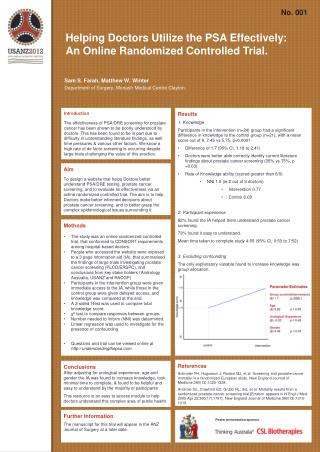
This study investigates the effectiveness of an online intervention designed to improve doctors' understanding of PSA/DRE testing for prostate cancer screening. Results indicated significant knowledge gains in the intervention group, with average scores rising from 5.75 to 7.45 (p < 0.0001). Eighty-two percent of participants found the information aid helpful, and 73% reported it was easy to understand. The trial suggests that structured online resources can effectively inform healthcare professionals about complex topics like prostate cancer screening.

E N D
No. 001 Helping Doctors Utilize the PSA Effectively: An Online Randomized Controlled Trial. Sam S. Farah, Matthew W. Winter Department of Surgery, Monash Medical Centre Clayton. Introduction The effectiveness of PSA/DRE screening for prostate cancer has been shown to be poorly understood by doctors. This has been found to be in part due to difficulty in understanding literature findings, as well time pressures & various other factors. We know a high rate of de facto screening is occurring despite large trials challenging the value of this practice. • Results • 1. Knowledge • Participants in the intervention (n=24) group had a significant difference in knowledge to the control group (n=21), with a mean score out of 9, 7.45 vs 5.75, p<0.0001 • Difference of 1.7 (95% CI, 1.18 to 2.41) • Doctors were better able correctly identify current literature findings about prostate cancer screening (35% vs 75%, p =0.03). • Rate of Knowledge ability (scored greater than 6/9) • NNI 1.5 (ie2 out of 3 doctors) • Intervention 0.77 • Control 0.09 • 2. Participant experience • 82% found the IA helped them understand prostate cancer screening. • 73% found it easy to understand. • Mean time taken to complete study 4:05 (95% CI, 0:53 to 7:52) • 3. Excluding confounding • The only explanatory variable found to increase knowledge was group allocation. Aim To design a website that helps Doctors better understand PSA/DRE testing, prostate cancer screening, and to evaluate its effectiveness via an online randomized controlled trial. The aim is to help Doctors make better informed decisions about prostate cancer screening, and to better grasp the complex epidemiological issues surrounding it. • Methods • The study was an online randomized controlled trial, that conformed to CONSORT requirements among hospital-based doctors. • People who accessed the website were exposed to a 3 page information aid (IA), that summarised the findings of large trials investigating prostate cancer screening (PLCO/ERSPC), and conclusions from key stake holders (Andrology Australia, USANZ and RACGP) • Participants in the intervention group were given immediate access to the IA, while those in the control group were given delayed access, and knowledge was compared at the end. • A 2-sided t-test was used to compare total knowledge score. • χ2test to compare responses between groups. • Number needed to inform (NNI) was determined. • Linear regression was used to investigate for the presence of confounding. • Questions and trial can be viewed online at http://understandingthepsa.com References Schroder FH, Hugosson J, Roobol MJ, et al. Screening and prostate-cancer mortality in a randomized European study. New England Journal of Medicine.360(13):1320-1328. Andriole GL, Crawford ED, Grubb RL, 3rd, et al. Mortality results from a randomized prostate-cancer screening trial.[Erratum appears in N Engl J Med. 2009 Apr 23;360(17):1797]. New England Journal of Medicine.360(13):1310-1319. Conclusions After adjusting for urological experience, age and gender the IA was found to increase knowledge, took minimal time to complete, & found to be helpful and easy to understand by the majority of participants This resource is an easy to access module to help doctors understand this complex area of public health. Further Information The manuscript for this trial will appear in the ANZ Journal of Surgery at a later date. Poster presentation sponsor