
### Understanding the Diversity and Importance of Bacteria Kingdom ###
E N D
Presentation Transcript
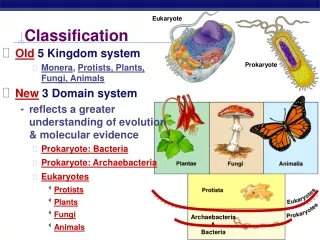
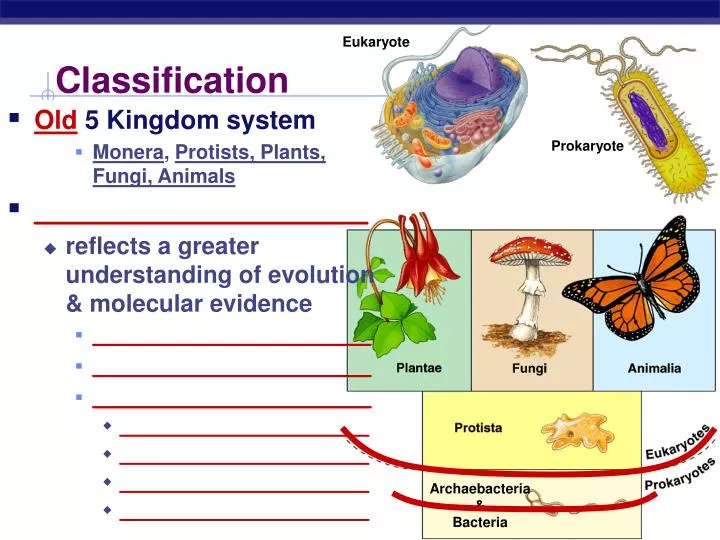
Eukaryote Prokaryote Archaebacteria&Bacteria Classification • Old 5 Kingdom system • Monera, Protists, Plants, Fungi, Animals • _______________________ • reflects a greater understanding of evolution & molecular evidence • _________________________ • _________________________ • _________________________ • _________________________ • _________________________ • _________________________ • _________________________
Kingdom_______________ Kingdom _______________ Kingdom _______________ Kingdom _______________ Kingdom _______________ Kingdom _______________
Domain Bacteria Domain Archaea Domain Eukarya Common ancestor Prokaryotes Domain Bacteria Domain Archaebacteria
Bacteria live EVERYWHERE! • Bacteria live in all ecosystems • on plants & animals • in plants & animals • in the soil • in depths of the oceans • in extreme cold • in extreme hot • in extreme salt • on the living • on the dead Microbes alwaysfind a way tomake a living!
Bacterial diversity rods and spheres and spirals… Oh My!
eukaryote cell prokaryotecell Prokaryote Structure • Unicellular • bacilli, cocci, spirilli • Size • 1/10 size of eukaryote cell • 1 micron (1um) • Internal structure • no internal compartments • ________________________________ • ________________________________ • _____________________________ • not wrapped around proteins
Prokaryote vs. Eukaryote Chromosome Prokaryote Eukaryote double helix
mitochondria chloroplast Variations in Cell Interior cyanobacterium(photosythetic) bacterium aerobic bacterium internal membranesfor respirationlike a mitochondrion(cristae) internal membranesfor photosynthesislike a chloroplast(thylakoids)
outer membrane of lipopolysaccharides Gram-negative bacteria Gram-positive bacteria peptide side chains outer membrane cell wall peptidoglycan cell wall peptidoglycan plasma membrane plasma membrane protein Prokaryote Cell Wall Structure That’simportant foryour doctorto know! peptidoglycan = polysaccharides + amino acid chains lipopolysaccharides = lipids + polysaccharides
Prokaryotic metabolism • How do bacteria acquire their energy & nutrients? • photoautotrophs • photosynthetic bacteria • chemoautotrophs • oxidize inorganic compounds • nitrogen, sulfur, hydrogen… • heterotrophs • live on plant & animal matter • decomposers & pathogens
Genetic variation in bacteria • Mutations • bacteria can reproduce every 20 minutes • binary fission • error rate in copying DNA • 1 in every 200 bacteria has a mutation • you have billions of E. coli in your gut! • lots of mutation potential! • Genetic recombination • bacteria swap genes • ____________________ • small supplemental circles of DNA • ____________________ • direct transfer of DNA conjugation
Bacteria as pathogens • Disease-causing microbes • plant diseases • wilts, fruit rot, blights • animal diseases • tooth decay, ulcers • anthrax, botulism • plague, leprosy, “flesh-eating” disease • STDs: gonorrhea, chlamydia • typhoid, cholera • TB, pneumonia • lyme disease
Bacteria as beneficial (& necessary) • Life on Earth is dependent on bacteria • _______________________ • recycling of nutrients from dead to living • _______________________ • only organisms that can fix N from atmosphere • needed for synthesis of proteins & nucleic acids • plant root nodules • help in digestion (E. coli) • digest cellulose for herbivores • cellulase enzyme • produce vitamins K & B12 for humans • produce foods & medicines • from yogurt to insulin
Got any Questions?? Ask da’ Boss!