
Socialisation: The Crucial Process of Cultural Learning
E N D
Presentation Transcript
Socialisation This is the process of learning how to behave in a way that is appropriate and acceptable to your culture.
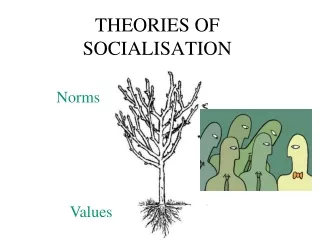
Primary socialisation • This takes place in early childhood. • It usually takes place in the home. • It offers the basic norms and values of the family and the culture
Secondary socialisation • This involves external agencies and modifies the primary socialisation. • It teaches norms for specific situations and can be interpersonal (teacher and pupil) or impersonal (media to audience)
Agencies of Socialisation • There are a variety of agencies of socialisation: • Family, • Peer group • Education • Religion • Mass media
Functionalists • These are generally American thinkers. • They say that the purpose of socialisation is to unite society in a set of shared norms and values. • This is a ‘consensus’ sociology.
Marxists • These people say that the purpose of socialisation is to control the weak and defenceless and to give them the ideas that the powerful promote. • People are taught an ideology • This is known as ‘conflict’ sociology.
Thus … • Agencies of socialisation are also agencies of social control. • Which viewpoint (Marxist or functionalist) you accept is your choice. • Be certain you can support your view with evidence.
Conclusions • You are taught the rules of your society throughout your life. • You share cultural values with people around you. • Socialisation gives you a social identity. • You may or may not be experiencing mind control – but if you are, you are probably not aware of it.