Curvature-Driven Sorting of Peripheral Proteins on Engineered Wavy Membranes
10 likes | 141 Vues
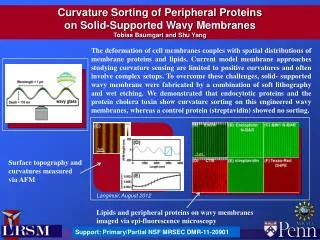
This study by Tobias Baumgart and Shu Yang explores the interaction between cell membrane curvature and the spatial distribution of membrane proteins and lipids. Traditional models for curvature sensing focus on positive curvatures and require complex setups, limiting their application. To address these limitations, we created solid-supported wavy membranes using soft lithography and wet etching techniques. Our findings reveal that certain endocytotic proteins and cholera toxin exhibit curvature sorting on these membranes, while streptavidin does not, highlighting the role of surface topography in protein behavior.


Curvature-Driven Sorting of Peripheral Proteins on Engineered Wavy Membranes
E N D
Presentation Transcript
Curvature Sorting of Peripheral Proteins on Solid-Supported Wavy Membranes Tobias Baumgartand Shu Yang The deformation of cell membranes couples with spatial distributions of membrane proteins and lipids. Current model membrane approaches studying curvature sensing are limited to positive curvatures and often involve complex setups. To overcome these challenges, solid- supported wavy membrane were fabricated by a combination of soft lithography and wet etching. We demonstrated that endocytotic proteins and the protein cholera toxin show curvature sorting on this engineered wavy membranes, whereas a control protein (streptavidin) showed no sorting. Surface topography and curvatures measured via AFM Langmuir, August 2012 Lipids and peripheral proteins on wavy membranes imaged via epi-fluorescence microscopy Support: Primary/Partial NSF MRSEC DMR-11-20901