Download
1 / 5
50 likes | 175 Vues
On September 6, 2012, students engaged in timed tests across various subjects, including Math and Science. Students completed questions from sections 1-3 in Math, while Science classes focused on exploring and classifying life, including guided notes and lab activities. Homework assignments were given for upcoming due dates. The day also featured an important discussion on hurricane paths, emphasizing how weather patterns and historical data guide understanding of hurricanes. The Coriolis effect's influence on hurricane formation and trends was highlighted, raising concerns about increasing hurricane frequency and power.

E N D
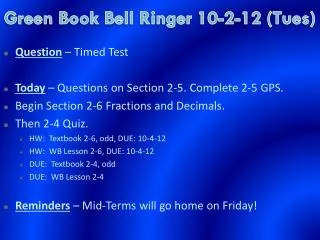
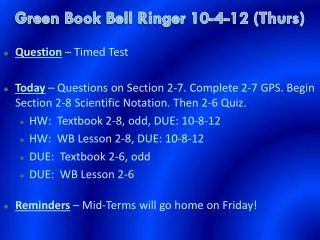
Green Book Bell Ringer 9-6-12 (Thurs) • Question:Timed Test • Today: Questions on Section 1-3. Complete 1-3 GPS. Begin Section 1-4 Dividing Decimals. Complete 1-4 DNG in class and some 1-4 Practice. Then 1-1 and 1-2 Quiz. • HW: Textbook 1-4, odd, DUE: 9-10-12 • HW: WB Lesson 1-4, DUE: 9-10-12 • DUE: Textbook 1-2, odd • DUE: WB Lesson 1-2
6/7th Science Bell Ringer 9-6-12 (Thurs) • Question: No Question Today. • Today: Complete Exploring and Classifying Life – Section 1 - What is Science Guided Notes. • Handout – How Science Works – Put in your Science Binders • Handout – SI Unit – Put in your Science Binders • Handout – Detailed Scientific Method – Put in your Science Binders • HW: Classifying Life Vocab, DUE: 9-7-12 • HW: Classifying Life Note Taking Guide, DUE: 9-11-12 • HW: Exploring and Classifying Life Worksheet, DUE: 9-7-12
Blue Book Bell Ringer 9-6-12 (Thurs) • Questions:Timed Test • Today: Questions on Section 1-2. Complete 1-2 GPS. Begin Section 1-3 Properties of Numbers. 1-3 DNG and part of the 1-3 Practice. Then 1-2 Quiz. • HW: Textbook 1-3, odd, DUE: 9-10-12 • HW: WB Lesson 1-3, DUE: 9-10-12 • DUE: Textbook 1-2, odd • DUE: WB Lesson 1-2
5th Science Bell Ringer 9-6-12 (Thurs) • Question: Name the parts of plants and their functions. • Today:Complete Using Carbon Dioxide Lab, put in Lab Books • DUE: 9-7-12 • Continue Guided Notes, Lesson 2: How Is Energy Passed Through and Ecosystem? • HW: Energy and Ecosystems Notetaking Guide, DUE: 9-11-12 • 9-7-12–Ordering What Eats What Lab • DUE: 9-12-12
Hurricane Paths on Planet Earth • Explanation: Should you be worried about hurricanes? • To find out, it is useful to know where hurricanes have gone in the past. The Earth map shows the path of every hurricane reported since 1851. • Although striking, a growing incompleteness exists in the data the further one looks back in time. • The map graphically indicates that hurricanes - sometimes called cyclones or typhoons depending on where they form -- usually occur over water, which makes sense since evaporating warm water gives them energy. • The map also shows that hurricanes never cross - or even occur very near - the Earth's equator, since the Coriolis effect goes to zero there, and hurricanes need the Coriolis force to circulate. • The Coriolis force also causes hurricane paths to arc away from the equator. • Although incompleteness fogs long term trends and the prevalence of hurricanes remains a topic of research, evidence is accumulating that hurricanes are, on the average, more common and more powerful in the North Atlantic Ocean over the past 20 years.