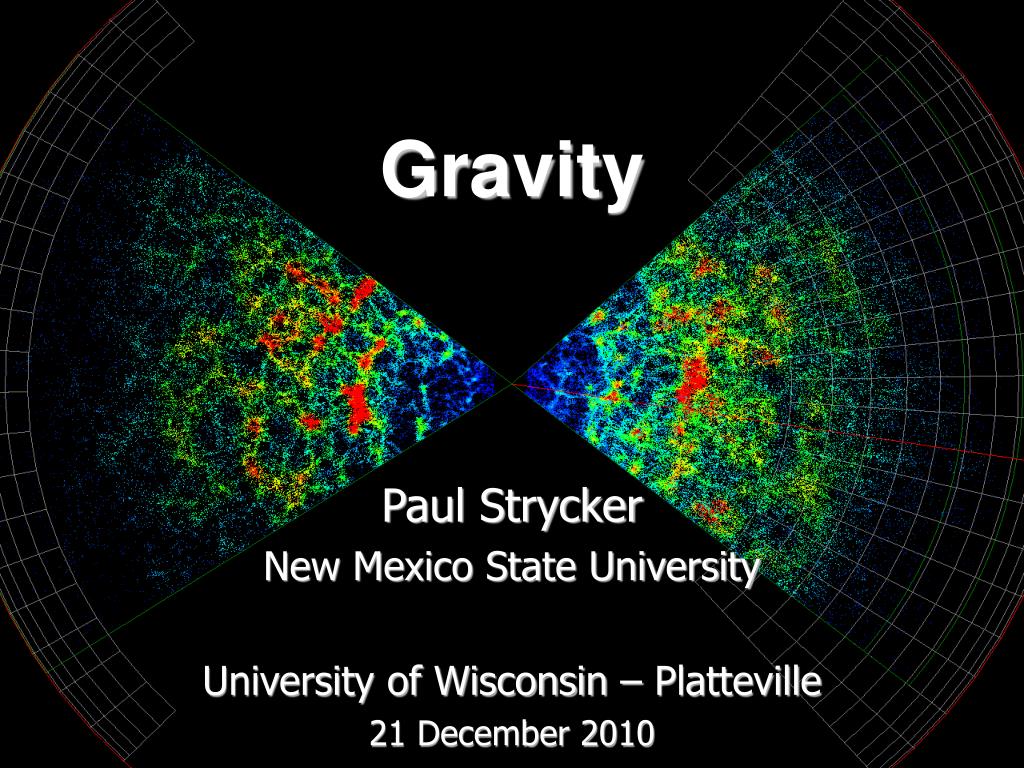
Gravity Paul Strycker New Mexico State University University of Wisconsin – Platteville 21 December 2010
Teaching Philosophy I want you to learn. I cannot learn for you. However, I can help you make the effort! Therefore, seek help and ask questions.
Teaching Philosophy Using your brain helps you learn. I cannot use your brain (directly). However, I can present you with situations that require you to use it! Therefore, take these opportunities.
Teaching Philosophy • Today we will use two approaches to engage your brain: • Prediction • Communication (speaking and listening) • We think before/during/after we speak. • We think more carefully about what is said if we doubt the speaker is trustworthy on the subject.
Assemble Your Team Each table is a team. Four to a team, if possible. Rearrange now if necessary. Introduce yourselves!
Review: Forces and Accelerations Have a member from your team take enough copies for each person to have one.
Review: Forces and Accelerations Each case (A-D) shows the position of just one object at two separate times.
Review: Forces and Accelerations Answer individually first: • Which situation(s) require a force to act upon the object? Why? • Draw the path of each object between times 1 and 2. • Does the direction of the force and/or acceleration change along your paths? • In which direction is the acceleration? • In which direction is the force? Now agree upon answers as a team.
Review: Forces and Accelerations Answer individually first: • In which situation(s) could gravity be the force responsible? • If gravity is responsible, then where would the other object be? • Is the path of each object still reasonable (where gravity is responsible)? Update it if necessary. • Does the direction of the force and/or acceleration change along your paths? Now agree upon answers as a team.
Case A No other object is needed to supply a force due to gravity. No Acceleration
Acceleration Case B
Acceleration Case C
Acceleration Case D
Universal Gravitation In 1665, Newton began to wonder if gravity might extend to the distance of the Moon. Orbit Animation
Universal Gravitation The acceleration required for the Moon is always directed straight toward the Earth. This is the same direction as our daily experience of acceleration due to gravity.
Universal Gravitation Our experiences with gravity are very limited. We will never change our distance from the center of the Earth by more than 0.1%. (Lucky astronauts.)
Team Discussion Question If the Sun suddenly collapsed and became a Black Hole, what would happen to the orbits of objects in the solar system? (What physical quantities do the force due to gravity depend upon?)
Start/Finish Line 200 115 1 150 The Orbit Race You are currently in a circular orbit. Choose your initial velocity. The first team to orbit the Earth and cross the finish line wins! http://phet.colorado.edu/sims/my-solar-system/my-solar-system_en.html
What was the Winning Strategy? High acceleration was more important than a high velocity! Orbit Animation
Start/Finish Line 200 115 1 150 Another Orbit Race Change your initial mass OR the mass of the Earth. Not both. The first team to orbit the Earth and cross the finish line wins! http://phet.colorado.edu/sims/my-solar-system/my-solar-system_en.html
What was the Winning Strategy? Higher acceleration was achieved by increasing the mass.
The Universal Law of Gravitation When did the acceleration increase? Force of Gravity increases with both masses. Force of Gravity decreases with distance. Mass1 and Mass2 Force of Gravity ~ and Distance
What will happen to each object? Mass: 100 X-pos: -200 Mass: 100 X-pos: 200 Mass: 1 X-pos: 0 http://phet.colorado.edu/sims/my-solar-system/my-solar-system_en.html
What will happen to each object? Mass: 100 X-pos: -400 Mass: 100 X-pos: 200 Mass: 1 X-pos: 0 http://phet.colorado.edu/sims/my-solar-system/my-solar-system_en.html
What mass will balance the middle body at the start? Mass: 100 X-pos: -400 Mass: 100 X-pos: 200 Mass: 1 X-pos: 0 http://phet.colorado.edu/sims/my-solar-system/my-solar-system_en.html
The Universal Law of Gravitation The distance was doubled. By how much did you need to change the mass to start the middle body in balance? Double? Less? More? Mass1 * Mass2 Force of Gravity = * G Distance * Distance
Now tie these two together... What will happen to each object?
The Structure of the Universe The structure of the Universe is primarily determined by gravity on all scales larger than a few kilometers.
The Structure of the Universe
The Structure of the Universe
The Structure of the Universe
Team Discussion Question If the Sun suddenly collapsed and became a Black Hole, what would happen to the orbits of objects in the solar system? A) Everything in the solar system would continue in their original orbits as if nothing had happened. B) Close objects (like Mercury) would fall into the Black Hole, but everything else in the solar system would not. C) The smaller objects in the solar system (asteroids, comets, and dust) would fall into the Black Hole, but the larger objects would not. D) The larger objects in the solar system would fall into the Black Hole, but the smaller objects would not. E) Everything in the solar system would fall into the Black Hole.
Homework Total Eclipse of the Moon 21 December 2010 Begins at 23:29 Greatest Eclipse at 02:17 (on 22 December)