Comprehensive Guide to Forecasting Models and Methods for New Product Success
This lecture by Dr. Geurts delves into various forecasting models and methods, essential for predicting the market success of new products. Key topics include buyer intention surveys, test markets, diffusion models, and econometric models. Learn about judgmental models, conjoint analysis, time series analysis, and the impact of technological factors. The session emphasizes using past data patterns to refine forecasts and enhance decision-making in budgeting, production planning, and inventory control. Gain insights into effectively assessing promotional impacts against forecasts.

Comprehensive Guide to Forecasting Models and Methods for New Product Success
E N D
Presentation Transcript
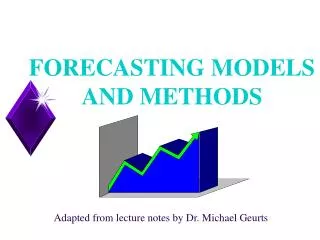
FORECASTING MODELS AND METHODS Dr. Geurts Lecture
New Products • 1. Buyer intention surveys: • Definitely will buy • Highly possible • As likely as unlikely to buy • highly doubtful to buy • Definitely will not buy • 2. Test markets • 3. Flow through or economic study • 4. Diffusion models = rate of adoption imitators/innovators • 5. Product comparable
New Products- con’t • 6. Judgmental models = expert guess, Delphi • 7. New product models like dumps: • Durability • Number of potential Users • Number of Major competitors • Number of Potential customers • Proportion made aware [ MARKET Share ] • 8. Conjoint analysis = determine value of product attributes an estimate market share. • 9. Trend/fashion forecasts = Innovators
Existing Product Sales • 10. Business activity = capacity being used • 11. Time series = past data patterns • a. exponential smoothing • b. Box-Jenkins [ARIMA] • 12. Response models = Sales and marketing mix variables • 13. Econometric models = Using economic indicators • 14. Salesmen composite = Summation of salesman forecast for her territory • 15. Logistic regression = combination of marketing mix variables and time series forecasts.
Other Forecasting Methods • 15. Technological • 16. Combining forecasts • 17. Partitioned data • 18. Regression • 19. Interest rates • 20. Economic Growth
Role of Data • Bad • Past • Other forecasts • Uses of Forecasts • Budgets • Production quantities • Inventory control • Planning • Bank loans • Identify effect of problems or promotions. If the forecasting has been accurate and the company runs a promotion. The company can measure the effects of the promotion as the difference between forecast and actual.