Comprehensive Guide to Circuit Analysis Using Equivalent Resistance
This guide walks you through the essential techniques of circuit analysis focused on equivalent resistance. It details the step-by-step process of simplifying complex circuits by combining series and parallel resistors. Starting from simple configurations, we methodically combine resistors to reach a final equivalent resistance. The application of Ohm's Law is emphasized throughout to compute voltages and currents across individual resistors after simplification. This resource is ideal for electrical engineering students and enthusiasts seeking to deepen their understanding of circuit behavior.

Comprehensive Guide to Circuit Analysis Using Equivalent Resistance
E N D
Presentation Transcript
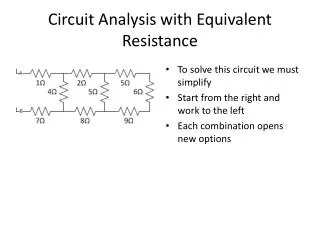
Circuit Analysis with Equivalent Resistance To solve this circuit we must simplify Start from the right and work to the left Each combination opens new options
Combine the Series Resistors Series resistors R(equiv) = R1 + R2 + R3 R(equiv) = 5Ω + 6Ω + 9Ω R(equiv) = 20Ω R1 R2 R3 Req
Combine the Parallel Resistors Now the 5 Ohm and 20 Ohm resistors are in a parallel configuration. R(equiv) = 1/((1/R1)+(1/R2)) R(equiv) = 1/((1/5) + (1/20)) R(equiv) = 1/((4/20)+(1/20)) R(equiv) = 1/(5/20) R(equiv) = 4Ω R2 R1 Req
More Series Combination R1 Series resistors R(equiv) = R1 + R2 + R3 R(equiv) = 2Ω+ 4Ω+ 8Ω R(equiv) = 14Ω R2 R3 Req
More Parallel Combination Now the 14 Ohm and 4 Ohm resistors are in a parallel configuration. R(equiv) = 1/((1/R1)+(1/R2)) R(equiv) = 1/((1/4) + (1/14)) R(equiv) = 1/((14/56)+(4/56)) R(equiv) = 1/(18/56) R(equiv) = 3.11Ω R1 R2 Req
Final Series Combination R1 A final series combination completes the circuit simplification Series resistors R(equiv) = R1 + R2 + R3 R(equiv) = 1Ω+ 3.11Ω+ 7Ω R(equiv) = 11.11Ω R2 R3 Req
Work back to find all voltages and currents to solve circuit Total current through circuit V/R = I In a series circuit, the current is the same through each resistor Sum of voltage drops is equal to the voltage drop across equivalent resistor Use Ohms law to find the voltage drop across each resistor V = IR for each resistor Example with 24 V applied across A and B
Same Voltage Across Parallel Components Voltage drop across the equivalent resistor is the voltage drop across each of the resistors Sum of the currents is equal to the current through the equivalent resistor Current Divided Use Ohms Law to get the current across each of the resistors I = V/R for each resistor Voltage from previous
Series Resistors Divide Voltage In a series circuit, the current is the same through each resistor Sum of voltage drops is equal to the voltage drop across equivalent resistor Use Ohms law to find the voltage drop across each resistor V = IR for each resistor Current from previous
Parallel Resistors Divide Current Voltage drop across the equivalent resistor is the voltage drop across each of the resistors Sum of the currents is equal to the current through the equivalent resistor Use Ohms Law to get the current across each of the resistors I = V/R for each resistor Voltage from previous
More Series Voltage Division In a series circuit, the current is the same through each resistor Sum of voltage drops is equal to the voltage drop across equivalent resistor Use Ohms law to find the voltage drop across each resistor V = IR for each resistor Current from previous