Download
1 / 32
320 likes | 451 Vues
This article explores the concept of resting membrane potential in neurons, focusing on the role of selectively permeable channels and ion concentration differences. It discusses the Nernst relationship, which helps calculate equilibrium potentials for specific ions, and highlights the importance of ion pumps in maintaining membrane potential. Key topics include the functions of proteins in the neural membrane, sodium and potassium ion distribution, and implications of oxygen deprivation on neuronal activity. Readers will gain insights into the fundamentals of nerve signal transmission.

E N D
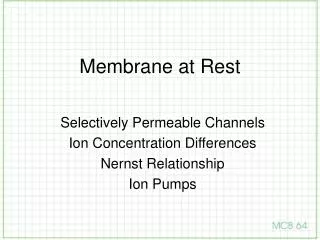
Membrane at Rest Selectively Permeable Channels Ion Concentration Differences Nernst Relationship Ion Pumps
Nernst Relation E = 61.54 mV log10 [ion] out/ [ion]in Lets call it 60 mV
Goldman Equation Vm = 60 log10 Pk[Ko] + PNa[Nao] Pk[Kin] + PNa[Nain]
Questions • What two functions do proteins in the neural membrane perform to establish and maintain the resting membrane potential? • ON which side of the membrane are sodium ions more abundant? • When the membrane is at the potassium equilibrium potential, in which direction (in or out) is there a net movement of potassium ions? • There is much greater concentration of potassium ions inside than outside the membrane. Why, then is the resting potential negative? • When the brain is deprived of oxygen, the mitochondria within neurons cease producing ATP. What effect would this have on the membrane potential? Why?
Next Class • Chapter 4 The Action Potential