The Impact of the Industrial Revolution and Civil War on American Industry and Society
170 likes | 296 Vues
The Industrial Revolution, spurred by the Civil War, transformed the U.S. economy, challenging industries to produce rapidly due to increasing demands for weapons, food, and clothing. Innovations in transportation, like railroads, were crucial for moving goods. Abundant natural resources, such as coal and oil, fueled industrial growth while immigration provided a robust workforce. Capitalism thrived, empowering entrepreneurs and leading to inventions by figures like Thomas Edison and Henry Bessemer. However, the shift to urbanization brought about lifestyle changes, pollution, and the establishment of national parks for conservation.


The Impact of the Industrial Revolution and Civil War on American Industry and Society
E N D
Presentation Transcript
Civil War Increases Industry • Challenged industry to produce at a faster rate • Need more guns, ammo, clothing, etc. • Food companies had to develop ways to transport food over long distances • Increased the need and the production of railroads.
Natural Resources Boost Growth • The Availability of resources also helped the revolution. • Coal Mines feed railroads and factories • Forests helped construction • Oil was discovered in 1859 in Pennsylvania by Edwin Drake • Better than whale oil • Led to kerosene and gasoline
The Workforce Grows • Immigration increased post civil war • Europeans • Chinese • Pushed out by conflict , political upheaval, and religious discrimination. • In 1881 nearly 750,000 immigrants arrive • In 1905 it was nearly 1 million. • Famine, locust and competition moved more farmers to the cities for jobs
Capitalism and Entrepreneurs • The American Dream • Street life in New York, a book by Horatio Algers in 1868 tells the story of Ragged Dick who goes from rags to riches through hard work. • Became the story of the American dream and increased through capitalism • Where individuals own the majority of their businesses. • Capitalism lends itself to Entrepreneurs, • People who invest money in a product or enterprise to make a profit
Government encourages industry • Lincoln green lighted a Trans-continental Railroad • $2 billion dollars in today's money • Couldn’t afford it • Paid the company with land in return for the work. • Protective Tariffs • Encouraged buying American goods by taxing foreign goods to make them cost more. • Laissez-Faire policies • Working with little government interference
Innovations • Drive to improve life and work lead to the increase of inventions • Patents numbers quickly increase • Government grant giving the inventor exclusive rights to develop, use, and sell and invention for a set period of time
Thomas Edison • New Jersey man with very little formal education • Gets more than 1000 patents • Established a research lab • Investors like JP Morgan helped finance it • Invents light bulb to light homes • Creates plan to light cities with electrical grid
Other Inventors • George Westinghouse • Creates way to send electricity long distances • Samuel F.B. Morse • Electrical telegraph communication • Alexander Graham Bell • Telephone • By 1900 there are more than 1,000,000 telephones
Steel • Henry Bessemer • Englishman • Invents the process to turn iron into steel • The Bessemer Process • By 1890 the US was out producing the British in steel manufacturing • Made possible the invention of Skyscrapers, Elevators, and Suspension Bridges
Brooklyn Bridge • First Suspension Bridge in the world • Built to cross the East River in New York • Completed in 1883 and at the time was the longest bridge in the world
Technology Improves Transportation • George Westinghouse invents Air Brakes for trains • Granville woods invents telegraph for trains • By 1883 there were 3 transcontinental railroads. • Railroads lead to time zones • Train schedules impossible without them • Streetcars, subways and the first airplane flight in 1903 all help spread out the country
Transportation leads to more change. • Improvement speeds up the spread of goods • Obtain goods and sell goods quickly • Network management translated to business management • Factories created plate glass windows for passenger cars • Factories produce railcars which move goods and produce more factories
Henry Ford • Perfected the assembly line and used mass produced parts to speed up production • Interchangeable parts created by Eli Whitney • Ford took these and made an assembly line to produce products at a faster rate • Mass production and assembly lines would fuel more industrialization
Impact of Industry • By 1880s American Exports of grain, steel, and textiles dominated international markets • US had more railroad tracks than the rest of the world combined • Making moving and shipping goods easier and faster • Expanding and increasing the Economy • Made the US an international powerhouse and increasing international conflict and competition.
Changes in Lifestyle • Urbanization • People moved to cities for work and a “better life” • Farms mechanized leading to a decrease in farm jobs • Unemployed farmers moved to cities for work. • Many people had more access to goods than ever before • Higher cost of living lead people to perform repetitive jobs with little satisfaction
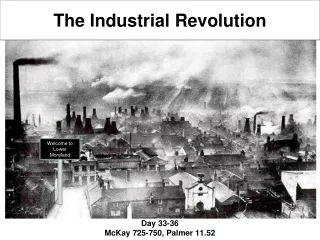
National Parks • Industry led to pollution in the late 1800s • Mining had destroyed the land • Soil erosion and dust storms were on the rise as the environment was impacted in new ways • In response Congress responded by setting aside protected lands that would eventually become the national parks • Yellowstone Park in 1872 was the first park and was in response to concern for the environment.