Download
1 / 15
150 likes | 279 Vues
The Industrial Revolution marked a dramatic shift in global economic power, elevating nations like Britain, Germany, France, the USA, and Japan. It spurred the rise of capitalism, leading to significant wealth accumulation for factory owners but worsening conditions for the working class. Urbanization resulted in poor living conditions and health crises. The population surged, while women's roles evolved and child labor became prevalent, necessitating reforms. The organization of labor ignited movements for workers' rights and ideologies like socialism and communism. The era also witnessed societal issues like crime and alcoholism alongside literacy growth.

E N D
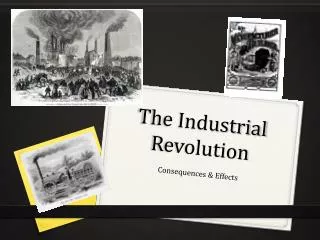
The Industrial Revolution Consequences & Effects
1. New leading nations with strong industrial economies • Britain, Germany, France • USA, Japan
The Industrial Revolution saw a previously inconsequentialpart of the world (EUROPE) become the centre of a new worldwide economy.
2. Riseofcapitalism • Capitalism became the most efficient and productive way to finance a country • Factoryowners and otherswhocontrolledthe means of productionquicklybecameveryrich • Workingclassconditionsbecameworse Greaterclass division
3. Urbanisation • Factory system Riseof modern city
Bad livingconditions; small houses, crampedstreets, dampness, opensewers • Chronic hunger and malnutrition • Diseases (TB, lungdiseases, cholera, typhoid)
4. Population Increase • The population of England and Wales, which had remained steady at 6 million from 1700 to 1740, rose dramatically after 1740. • The population of England had more than doubled from 8.3 million in 1801 to 16.8 million in 1850. • By 1901, had nearly doubled again to 30.5 million.
5. RoleofWomen • Long working days in the factories • Role of family changed drastically
6. Child Labour • Limited opportunity for education, and children were expected to work. • Worked in relatively bad conditions for much lower pay than their elders. • Children as young as 4 were employed. • Factory Acts of 1833 and 1844 limited use of child labour.
7. Organisation oflabour • Concentrationoflabourintofactories, mills and mines Trade unions Strike action • Socialism- Ideaofdividingwealth • Communism(1848)- Marx & Engels: The Communist Manifesto
9. Othereffects • Crime • Alcoholism • Increase in lifeexpectancy • Expansion ofnewspaper and popularbook publishing Rise in literacy