Download
1 / 15
150 likes | 275 Vues
Simpson College embarked on a comprehensive review of its General Education curriculum, leading to the development of the Engaged Citizenship Curriculum (ECC). The initiative addressed faculty concerns about outdated coursework and aimed to focus on student needs through an interdisciplinary approach. Key components include a First-Year Experience Course, Areas of Engagement courses covering civic engagement and global perspectives, and embedded skill courses. This new framework fosters higher student engagement and emphasizes critical civic skills necessary for responsible citizenship.

E N D
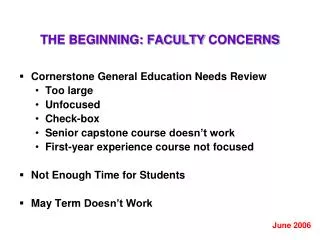
THE BEGINNING: FACULTY CONCERNS • Cornerstone General Education Needs Review • Too large • Unfocused • Check-box • Senior capstone course doesn’t work • First-year experience course not focused • Not Enough Time for Students • May Term Doesn’t Work June 2006
COLLEGE-WIDE STRATEGIC PLAN AND REVIEW OF COLLEGE MISSION STATEMENT RESULTS IN FIVE INITIATIVES • Intellectual and Practical Skills • Integrated Learning • Living and Working in a Global Context • Leadership • Personal and Social Responsibility Academic Year 2006-2007
STEP 1: Volunteer working groups are formed to respond to the strategic initiatives and answer the question, “Do we need to change?” • Academic Structures—10 faculty • Focused on credit structure, calendar, etc. • General Education—10 faculty • Focused on problems and opportunities in existing Cornerstone Program Summer 2007
STEP 2: Two elected working groups are formed to develop proposals for structural changes and general education changes • One focused on academic structure issues, the other on general education (approx. 30 faculty) • Together, both form the Learning Programs Working Group (LiPWAG) • The academic structures group was the first to bring its proposals to the full faculty
STEP 3: Faculty Approve Structural Changes Yes No Abstain April 2, 2008
STEP 4: The general education working group adopts principles for a new general education curriculum • FOCUS ON STUDENT NEEDS • BE DELIBERATE AND INTENTIONAL • BE INTERDISCIPLINARY • FOCUS ON INTELLECTUAL AND PRACTICAL SKILLS AND PERSONAL/SOCIAL RESPONSIBILITY • CONTAIN A FIRST-YEAR EXPERIENCE COURSE • CONTAIN BUILT-IN ASSESSMENT
STEP 5: The faculty considers potential general education models • Exposure Model (revision of Cornerstone Program) • Ways of Knowing Model • Big Questions/Enduring Questions Model • Great Books Model • Integrated/Concentration Model • Problem-based Model • Interdisciplinary Model Early 2008
STEP 6: Faculty select a focus and a model • What does it mean to be an engaged citizen? • How can Simpson College best prepare students to be engaged citizens? • Interdisciplinary Approach
STEP 7: The faculty approve the framework for general education • Component A: First-Year Experience Course A course to help students adapt to college life and work • Component B: Areas of Engagement Courses that answer the question, “What do I need to know to be an engaged citizen?” • Component C: Embedded Skills Courses that answer the question, “What do I need to be able to do to be an engaged citizen?” • Component D: Senior Capstone in Major A course in the major to demonstrate understanding and ability within a discipline August 21, 2008
STEP 8: 16 working groups (approx. 70 faculty) create learning objectives and criteria. The faculty unanimously approve the Engaged Citizenship Curriculum (ECC) • I SIMPSON COLLOQUIUM • II AREAS OF ENGAGEMENT • The Arts • Civic Engagement • Diversity and Power in the United States • Ethics and Value Inquiry • Global Perspectives • Historical Perspectives in Western Culture • Scientific Reasoning • III EMBEDDED SKILLS • Written Communication (4) • Quantitative Reasoning (2) • Critical Thinking (2) • Information Literacy (2) • Oral Communication (2) • Collaborative Leadership (2) • Intercultural Communication (1) • IV SENIOR CAPSTONE IN THE MAJOR April 2009
Area of Engagement: Civic Engagement Required Course Characteristics A course in this area will meet three of the following four requirements: • explore and critically evaluate the nature and definition of civic engagement and citizenship • foster knowledge of important issues in civic and political life • explore and critically evaluate pathways to social change • examine historic or contemporary groups or individuals who model civic engagement and active citizenship Area of Engagement Learning Objectives Through completion of a CE course, students should be able to: • demonstrate an understanding of information, values, processes and theories that are essential to building just and democratic societies • evaluate historical and current political and social issues in local, national and global contexts • apply the perspective of an academic discipline to civic initiatives • articulate the importance of being civically engaged individuals throughout their lives
THE NEW CURRICULUM MEETS THE STRATEGIC INITIATIVES OF THE COLLEGE
THE BIG PICTURE • Built on learning objectives and criteria • Focus on what students need to be productive and engaged citizens • Students take fewer courses, but go into more depth • More time outside of class for faculty and students working on hands-on projects • More time demonstrating ability
PROBLEMS ASSOCIATED WITH IMPLEMENTATION OF ECC • Faculty development needed for Embedded Skills • Encouraging new course development rather than adapting existing courses • Making sure enough courses meet the criteria • Holding true to the criteria • Transfer and Evening, Weekend, and Graduate Programs • Complications with reprogramming degree audits, billing, transcripts, etc.