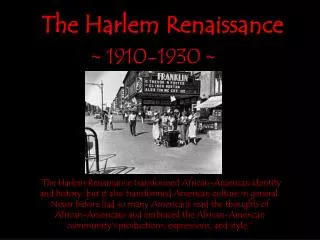
The Harlem Renaissance
120 likes | 278 Vues
The Harlem Renaissance. 1917-1935 American Lit 2 – Mr. Plinsky. Sattelite view of New York. Harlem is in north Manhattan (Manhattan Island street map). Five Burroughs of New York Manhattan (Blue Brooklyn (Yellow) Queens (Orange) Bronx (Red) Staten Island (Purple).


The Harlem Renaissance
E N D
Presentation Transcript
The Harlem Renaissance 1917-1935 American Lit 2 – Mr. Plinsky
Sattelite view of New York Harlem is in north Manhattan (Manhattan Island street map) • Five Burroughs of New York • Manhattan (Blue • Brooklyn (Yellow) • Queens (Orange) • Bronx (Red) • Staten Island (Purple)
The Harlem Renaissance • After the Civil War, there was a brief period of euphoria and cooperation between blacks and whites. • This did not last long, and spawned very few African-American writers, artists and actors. Image from http://americanhistory.si.edu/brown/history/1-segregated/detail/1st-blacks-of-congress.html
The Harlem Renaissance • WWI created economic prosperity for African-Americans in Northern states. • Labor shortage led to increased wages and employment • Up to 10% of the national African American population moved north. • From 1890 to 1930 New York City grew 10x in black population (30,000 to 300,000) Image fom http://americanhistory.si.edu/sweatshops/history/2t126.htm
The Harlem Renaissance • Over a dozen major authors appear in a 20 year time span. • In addition, the era produced African-American artists, musicians and scholars. • W.E.B. DuBois wrote that “until the art of the black folk compels recognition, they will not be treated as human.” • Artistic blossoming was also accompanied by the pursuit of increased rights for African Americans. • Birth of NAACP and National Urban League (NUL) W.E.B. Du Bois Image from http://www.msu.edu/~jtminor/hbcuproject.html
The Harlem Renaissance • Spread information about African American culture. • Was entirely unexpected by mainstream America. • Because of this, the period was also marked by 2 dozen or more racial riots nationwide, including Tulsa, OK and Omaha, NE. Image from http://www.tulsareparations.org/TulsaRiot.htm Image from http://www.assumption.edu/users/McClymer/his394/tulsaraceriot/default.html
The Harlem Renaissance • 1917 Ridgely Torrence and Emily Hapgood presented three all-black plays at the Provincetown Playhouse in New York City. • This was unheard of – all parts were dignified; the plays were dramatic, not burlesque. • This is considered the opening of the Harlem Renaissance. Ridgely Torrence
The Harlem Renaissance • Harlem Rennaissance breaks down into 3 phases: • 1917-1923 dominated by white authors who were deeply interested in African-American culture. • 1924-1926 Transition: interracial collaboration between African-American and white artists. • 1926-1935 Dominated by African-American artists coming into their own right. • Ended with the Harlem Riot, March 1935.
Harlem – the Neighborhood • Originally lots of empty housing due to overdevelopment – cheap, plentiful, good quality. • Became a predominantly African-American neighborhood with population migration into NYC. Images from http://www.eng.fju.edu.tw/ron/american_lit2/Images/harlem.htm
Harlem – the Neighborhood • Population: • 1890 – 33,888 • 1930 – 327,706 • Quality of housing decreased as units were subdivided • Disease spread due to overcrowding and bad sanitation. Image from http://www.eng.fju.edu.tw/ron/american_lit2/Images/harlem.htm Image from http://www.midtownmedia.com/ndc/Subway.html
Harlem – the Neighborhood • Vibrant, full of life, liberated, but not a pleasant place to live. • Most of the notable scholars and artists of the time lived there. Image from http://www.albany.edu/updates/1998/2-11/frontpage.html Image from http://brianabbott.net/blog/2005/07/16/the-tour-guide/