Download
1 / 45
450 likes | 572 Vues
The French Revolution (1789) marked a pivotal change in France, fueled by discontent with the Old Regime. This society was divided into three estates: the 1st Estate (clergy) and the 2nd Estate (nobility), both enjoying privileges and tax exemptions, while the discontented 3rd Estate (the majority, including the middle class, peasants, and urban workers) bore the burden of taxation. Enlightenment ideas ignited demands for equality and justice, culminating in events like the storming of the Bastille and the declaration of rights. Ultimately, the revolution paved the way for significant social and political reforms.

E N D
The French Revolution • The Old Regime • 1st Estate – Clergy - 1% of population • 2nd Estate – Nobility – 1% of population • 3rd Estate – Remainder of population • The Clergy • Very wealthy and powerful • Owned 10% of the land in France • Did not have to pay taxes • Enlightenment condemned the church and asked for reform
The French Revolution • The Nobles • Held the top positions in government, army and the courts • Did not pay taxes • Enjoyed endless entertainments • They were far removed from the 3rd estate
The French Revolution • The 3rd Estate • Bourgeoisie (middle class) • Bankers, merchants, lawyers, doctors, professors, artists and manufacturers • Peasants - 9 out of 10 in the 3rd estate • Urban workers – the rest of the 3rd estate • Apprentices, journeymen, printers, clothing makers, servants, stable hands, porters, construction workers and the unemployed
The French Revolution • Discontent • 3rd estate hated 2nd & 1st estate • Small raises in the price of bread meant starvation for many in the 3rd estate • 3rd estate hated taxes • Taxed on everything from land to soap to salt • Also taxed on road and bridge repair known as the Corvee tax • Peasants were not allowed to hunt • Could not even kill rabbits that ate their crops
The French Revolution • Enlightenment led the 3rd estate to begin to question the way of life in France • Economic Problems • Deficit spending • War debts • Seven years’ war • American revolution • Half of taxes collected went to pay interest on debt payments • Forced to raise taxes and reduce expenses
The French Revolution • Economic Troubles • Poor harvests • Led to high food prices • People began to starve • Led to bread riots • Failure to reform • Louis XIV and Louis XV continued to run up debts • Louis XVI – well meaning but weak and indecisive • Louis XVI appointed economic genius Jacques Necker • Necker proposes tax on 1st and 2nd estate • Met with much disgust • Nobles and Clergy force Louis XVI to dismiss Necker
The French Revolution • May 1789 - Louis XVI calls for the Estates General – first time in 175 years • Meeting of the estates to discuss the future of their government • Louis XVI asked all classes to prepare a list of complaints known as Cahiers • Each class had many complaints • 3rd class had the most
The French Revolution • Representatives of the 3rd estate were inspired by the Philosophes of the Enlightenment • Each estate usually got one vote – problem is 1st and 2nd estate always outnumbered 3rd estate • 3rd estate called for a vote with each person at the estate general getting a vote
The French Revolution • 3rd estate broke off and declared themselves the national assembly • They invited members of the other estate to help write a constitution • When the national assembly returned to the estate general the doors were locked and guarded by armed soldiers • The 3rd estate met on a nearby tennis court and took an oath “to never separate and meet whenever possible to write a new constitution”
The French Revolution • Some members of the 1st and 2nd estate started to agree with the 3rd estate • Louis XVI reluctantly agreed with the new constitution • Starvation continued and it was rumored that Louis XVI was going to dissolve the national assembly
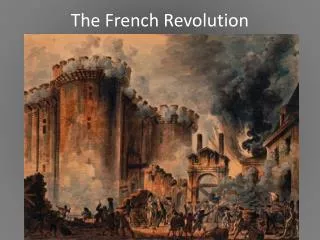
The French Revolution • 800 Parisians gather outside the medieval prison – The Bastille • They demanded the weapons and gunpowder inside • The leader of the Bastille had his troops open fire on the crowd • The mob broke through and killed the leader and five of his men – they released several prisoners as well • July 14th - Bastille Day is the beginning of the French Revolution
The French Revolution • France was experiencing the worst famine in hundreds of years • People spent 80% of their income on bread • The Great Fear • Rumors that led peasants to steal food and burn noble’s manors • Paris in Arms • Paris was the heart of the revolution
The French Revolution • Marquis de Lafayette • Fought alongside George Washington in the American Revolution • Headed the National Guard in France • Middle Class Militia • First to dawn the red, white, blue flag • Fought against the Royal army • After the storming of the Bastille the 1st and 2nd estate gave up many of their rights
The French Revolution • Declaration of the Rights of Man • Modeled after the American Declaration of Independence • Inspired by the Philosophes of the Enlightenment • Entitled to “Liberty, property, security and resistance to oppression” • All citizens are equal before the law • Freedom of religion • Louis XVI was reluctant to accept these reforms
Warm Up • Who made up the 1st Estate? • Who made up the 2nd Estate? • What two groups made up the 3rd Estate? • Which Estates had to pay taxes? • What 2 wars added to France’s debt? • Out of the 3rd Estate, what percentage were peasants? • What is the Bradley Effect when talking about elections?
Warm Up • What does estate mean in pre-revolution France? • Who made up each estate? What percentage of the population made up each? • What estate(s) paid taxes? • What percentage of peasants made up the 3rd estates? • What was the official beginning of the F/R? What happened on that day? • Who was king when the F/R started? • What was the Estates General? National Assembly? Tennis Court Oath? • Were Estates General common? • What movement inspired the 3rd estate to revolt? • What is deficit spending? • Who is the Bourgeoisie? • Where is President Obama currently visiting?
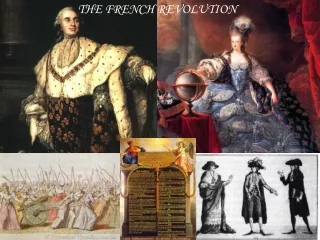
The French Revolution • Women march on Versailles • Thousands of French woman marched to the Louis’ palace demanding bread • Many were angered with Marie Antoinette • She continued to live lavishly • When Marie heard about the starving peasants it was reported she replied, “Let them eat cake” • This was untrue but hurt Antoinette’s image all the same • The women refused to leave until Louis XVI returned to Paris with them
The French Revolution • The national assembly • Reorganizes the church • They sell off all the church land to pay debts • Church was now under state control and all clergy had to be elected • Pope in Italy condemns this move • Constitution of 1791 • Created by the national assembly • Had a limited monarchy, legislative branch • Eliminated church control
The French Revolution • Louis XVI and Marie Antoinette attempt to flea Paris • Louis was disguised as a servant • They were at the edge of town put a peasant recognized Louis because his face was on the money he was holding • He and Antoinette were dragged back to Paris while onlookers hurled insults at them • This made Louis XVI look like a traitor to the revolution
The French Revolution • Widespread fears • Emigres – nobles and clergy who fled France spreading tales of the 3rd estate taking over • Catherine the Great (enlightened despot) heard these stories and burned Voltaire’s writings • Joseph II (Enlightened Despot) was Marie Antoinette’s brother – He threatened to invade France to protect the monarchy • France revolutionaries prepared for invasion from abroad
The French Revolution • Jacobins – A revolutionary political club • made up of the middle class and intellectuals • through pamphlets and newspapers they were the voice of the revolution • Aug., 1792 – a crowd of Parisians storm the Tuileries (where Louis and Antoinette were being held) and slaughter the King’s guards
The French Revolution • Louis XVI and Marie Antoinette are put on trial as traitors to France • Louis and Antoinette are sentenced to death • Guillotine – New execution device • Jan., 1793 – Louis XVI is beheaded • Oct., 1793 – Marie Antoinette is beheaded • Louis XVII died of an unknown cause in a dungeon
Warm Up • What was the primary source of food for the 3rd estate leading up to the French Revolution? What % of their income was spent on this product? • Who was Marquis de Lafayette? • What was the French equivalent of the Declaration of Independence? • What was the Women’s march to Versailles? • How were King Louis XVI and Marie Antoinette captured when they fled Paris? • Who was Marie Antoinette’s brother? What country did he rule? • What is an Émigré? • What did Enlightened despots do when they heard about the revolution in France? • How many electoral votes did Barack Obama receive?
The French Revolution • Maximillien Robespierre • Rose to the leadership role after the abolition of the monarchy • Robespierre was a Jacobin • Nicknamed “The incorruptible” • His enemies called him a tyrant • Heavily inspired by Rousseau • Believed in freedom of religion and wanted to abolish slavery • He hated the old regime of France • Used terror to drive the revolution • “Liberty cannot be secured unless criminals lose their heads”
The French Revolution • The Reign of Terror • Led by Robespierre • Revolutionary courts conducted hasty trials and spectators greeted death sentences with cries of “Hail the Republic” and “Death to the Traitors” • 40,000 killed during the Reign of Terror • 15% Nobles & Clergy • 15% Middle Class • 70% Peasants and anti-revolutionaries
The French Revolution • The Guillotine • Invented by Dr. Joseph Guillotine • Instant killer – more humanethan the ax • The public turns on Robespierre • He is arrested and executed the next day for leading the Reign of Terror • Executions slow down drastically after this
Warm Up • What was the Reign of Terror? • How many people were killed during the Reign of Terror? • What percentage of people killed were Clergy and Nobles? Middle Class? Peasants? • What was MaximillienRobespierre’s nickname? • Who was he heavily inspired by? • This major electronics store just filed for Chapter 11 (Bankruptcy). • What did our holiday on Tuesday celebrate?
The French Revolution • After Robespierre the revolution went into a third stage • 5 man directory and a two house legislature • Very weak • Émigrés return France • Supporters of the Monarchy win the majority of seats in the legislature • As chaos threatened they turned to a man named Napoleon Bonaparte
The French Revolution • The legislature thought they could use Napoleon as a puppet • They were greatly mistaken as Napoleon soon becomes ruler of France • France builds up a strong sense of Nationalism
The French Revolution • Napoleon’s rise to power • Military Lieutenant • Favored the Jacobins – but disagreed with some of their views • He was victorious in many military conflicts and rose through the ranks of the French Military • Shortly after being appointed to lead France he named himself Emperor for life • Napoleon invites the Pope to France • Napoleon takes the crown from the Pope and places it on his own head
The French Revolution • Napoleon strengthens the central government • Napoleon helps improve the economy • Makes peace with the Catholic Church • All estates liked Napoleon • Napoleonic code • New law under the rule of Napoleon • Embodied Enlightenment ideas, but valued order and authority over individual rights
Warm Up • What is the Napoleonic Code? • What was the Reign of Terror? Who led it? What was his nickname? • Approximately how many were killed during the Reign of Terror? What device killed them? • Who returns after the death of Robespierre (hint: it ain’t Napoleon)? How does this lead to Napoleon taking control of France? • Name at least 1 good thing Napoleon did? Name at least 1 bad thing? • What are the Pro’s and Con’s to strong nationalism? • Yesterday, what did President Obama decide to do in Afghanistan?
The French Revolution • Building an Empire • Napoleon led many swift victories over European countries • “A man such as I am cares little for the life of a million men” • Napoleon takes over the Netherlands, Belgium and parts of Italy, Prussia and Germany • He then put friends and relatives in charge of these new territories • Nationalism grows even stronger
The French Revolution • France vs. Britain • Britain relied on it’s strong navy • 1805 - Napoleon prepares to invade England • Napoleon loses at the battle of Trafalgar and the French fleet is destroyed • Napoleon waged economic warfare with England • Napoleon closed all ports in Europe to England • France and England seized neutral ships during this time • British ships continue to sink American ships and this leads to the war of 1812 • Napoleon’s tactics did not work against Britain
Challenges to Napoleon’s Empire • France and Napoleon sweep through Europe spreading French views on government and the role of the Church • Napoleonic code sweeps throughout Europe as well • French taught other European nations about nationalism • This works against France when other nations revolt against France
Challenges to Napoleon’s Empire • Resistance in Spain • Napoleon made his brother king of Spain • He also tried to eliminate the Catholic church • Spain started to believe in Nationalism • They challenged Napoleon and France • French crush most rebellions • This fuels the Spanish hatred for the French
Challenges to Napoleon’s Empire • Guerrilla Warfare • Style of fighting the Spanish used against France – used hit and run tactics – In Spanish guerrilla means “little war” • Britain sends Arthur Wellesley (Duke of Wellington) to help the Spanish fight the French • War With Austria • Spanish war with France encouraged Austria to revolt • France crushes this revolt • Napoleon divorces Josephine and marries the Austrian princess Marie Louise
Challenges to Napoleon’s Empire • Defeat in Russia • Napoleon’s Continental system made many unhappy • Czar Alexander I of Russia was particularly unhappy and withdrew from the Continental system • Napoleon reacted by assembling his grand army and heading for Russia • 400,000 French soldiers invade Russia
Challenges to Napoleon’s Empire • Defeat in Russia cont. • Russians retreat constantly, never really fighting a battle • In their retreat they used a tactic called “Scorched Earth” where they burned everything in their retreat in order to ensure that the French had no resources • French soldiers froze and starved • Napoleon reached Moscow but realized that he could not supply his army so he headed back home • Only 10,000 soldiers survived out of 400,000 • Napoleon’s image was shattered
Challenges to Napoleon’s Empire • Downfall of Napoleon • Napoleon and his depleted army are defeated at the battle of Leipzig • Napoleon abdicates (steps down from power) • He is exiled to Elba, an island in the Mediterranean • Louis XVIII, Brother of Louis XVI, takes the French throne • Napoleon escapes the island and returns • Louis XVIII flees
Challenges to Napoleon’s Empire • Napoleon rules for 100 days until he is defeated by the British at the Battle of Waterloo • British led by Duke of Wellington • This time Napoleon is sent to St. Helena, a lonely island in the South Atlantic • Napoleon dies in 1821 • Napoleon’s legacy • Napoleonic code • Spread Nationalism across Europe • Helped create a new Germany • Louisiana purchase – Doubles the size of the United States
Congress of Vienna • Goal was to restore Europe’s stability and create a lasting peace by protecting the monarchy • All major leaders from all European nations were in attendance • Met for 10 months 1814-1815 • They redrew the map of Europe • In doing so they contained France • The monarchy returns in most European nations • Germany gains a strong sense of Nationalism “Uh oh”
Warm Up • What is the Napoleonic Code? • What is the Continental System? • What tactic did Russia use to defeat Napoleon? • Who was Czar Alexander I? • Who was Arthur Wellesley ? • How many soldiers did Napoleon take to Russia? How many came back? • What is Nationalism? • What is Nepotism? • A fire in this area burned many celebrity homes last week.