High-Resolution Transient Flow Analysis for Accurate Well Performance Assessment
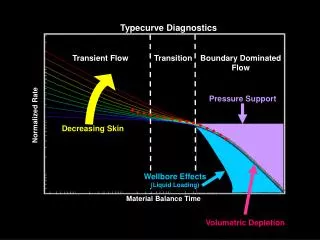
This comprehensive guide explores transient flow behavior in wells, focusing on boundary-dominated flow characteristics. It emphasizes the importance of high-resolution early-time characterization, enabling reliable flow regime identification throughout the well's lifecycle. Key processes include material balance, empirical decline analysis, and liquid loading effects, which offer insights into the estimation of fluids in place, recovery factors, and reservoir heterogeneities. Enhanced methods for analyzing transient production data facilitate accurate reserve estimates, drainage area characterization, and recovery projections under varying historical conditions.

High-Resolution Transient Flow Analysis for Accurate Well Performance Assessment
E N D
Presentation Transcript
Typecurve Diagnostics Transient Flow Boundary Dominated Flow Transition Pressure Support Normalized Rate Decreasing Skin Wellbore Effects (Liquid Loading) Material Balance Time Volumetric Depletion
Welltest Analysis Empirical Decline Analysis -High resolution, early-time characterization Modern Decline Analysis -Reliable flow regime characterization over life of well -Reliable estimation of fluids in place -Reliable estimation of RF -Ability to analyze transient prod data (early time, tight gas) -Projection of recovery constrained by historical operating conditions -Characterization of perm and skin -Estimation of contacted drainage area -Estimation of reserves when flowing pressure is unknown -Identification of layering/ regional heterogeneities -Identification of individual boundaries