Polar Coordinates
90 likes | 249 Vues
This guide explores the polar coordinate system, a crucial alternative to the Cartesian coordinate system. We delve into the definitions of polar coordinates, which describe points based on their distance from the origin (radius) and their angle relative to the polar axis. Key angles such as 30°, 60°, 90°, 120°, 150°, 180°, 210°, 240°, 270°, 300°, and 330° are discussed in relation to various radius vectors. Understanding these concepts is essential for applications in mathematics, physics, and engineering.


Polar Coordinates
E N D
Presentation Transcript
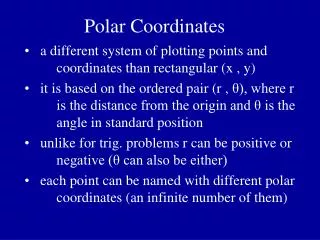
Common Coordinate Systems There are two common coordinate systems: Cartesian Rectangular Coordinate System Polar Coordinate System
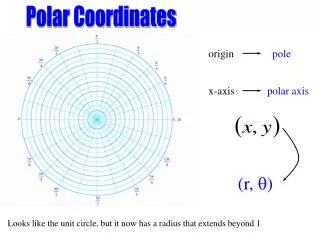
Understanding Polar Coordinates 90o 120o 60o 150o 30o Polar angle=150o Polar angle=180o Polar angle=60o Polar angle=120o Polar angle=90o radius vector=3 radius vector=5 radius vector=6 radius vector=4 radius vector=2 Polar angle=30o Polar angle=210o radius vector=1 Polar angle=240o 180o · Polar axis 0o 0 1 2 3 4 5 6 Polar angle=270o Polar angle=330o Polar angle=300o 210o 330o 240o 300o 270o
90o 120o 60o 150o 30o 180o 0o 1 2 3 4 5 6 210o 330o 240o 300o 270o 30o (3, ) 30o 0
90o 120o 60o 150o 30o 180o 0o 1 2 3 4 5 6 210o 330o 240o 300o 270o 150o (5, ) 150o 0
90o 120o 60o 150o 30o 180o 0o 1 2 3 4 5 6 210o 330o 240o 300o 270o 180o 0 (6, ) 180o
90o 120o 60o 150o 30o 180o 0o 1 2 3 4 5 6 210o 330o 240o 300o 270o 0 (2, ) 240o 240o
90o 120o 60o 150o 30o 180o 0o 1 2 3 4 5 6 210o 330o 240o 300o 270o 150o 150o (4, ) 150o (6, ) 150o 0 (4, ) 330o 330o The End